
CDP vs. Digital Twin: What's the Difference and Do You Need Both?
 Nehan Mumtaz
If you run marketing at a retail brand, you probably already have a customer data platform, or a CDP. It pulls together your email lists, your loyalty program, your point of sale data, and your website clicks into one clean customer profile. That's useful. It's also not the whole picture.
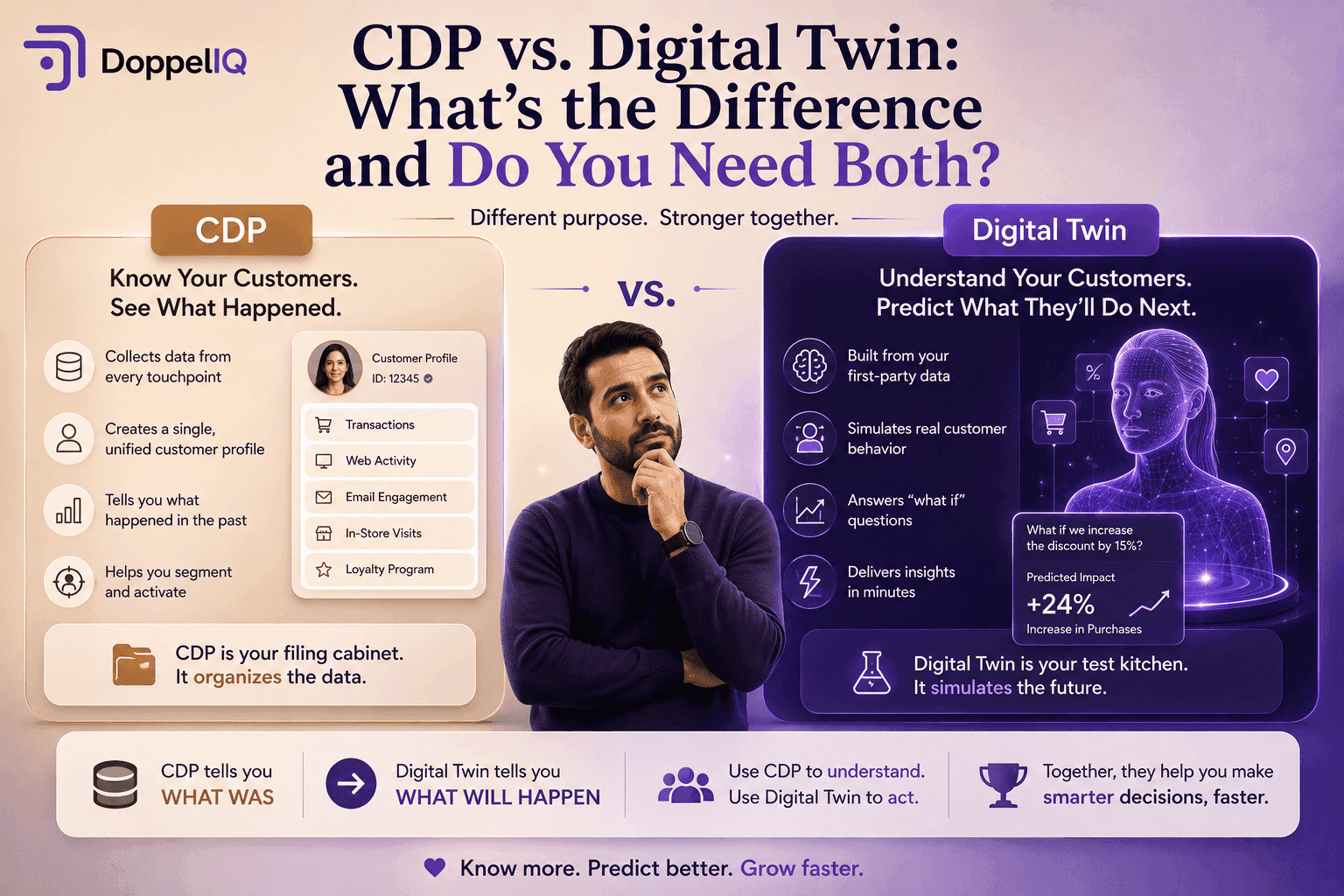
Here's the simplest way to think about it. A CDP is like a filing cabinet. It keeps every record about your customer organized so you can find it fast. An enterprise digital twin, like DoppelIQ, is more like a test kitchen. It lets you try out a new recipe on your customers before you ever put it on the menu.
You need the filing cabinet to know what's in your pantry. You need the test kitchen to know if people will actually order the dish. Let's break down why both matter, and where digital twins like DoppelIQ Enterprise fit next to the CDP you already have.
What a CDP Actually Gives You
A CDP's whole job is to answer one question: what happened? It watches every touchpoint, a purchase, an email open, a store visit, and stitches it into one profile per customer. That's genuinely hard to do, and CDPs solve it well.
But a CDP describes the past. It can tell you a customer bought sunscreen and flip-flops together last June. It cannot tell you if that same customer will switch to a competitor brand if you increase your price by 15% next month. That's a different kind of question, and it needs a different kind of tool.
Here's a quick way to see the difference between a CDP and the CRM your sales team already uses, since the two get mixed up a lot:
| CRM | CDP | |
|---|---|---|
| Who uses it | Sales and support teams | Marketing teams |
| What it tracks | Known contacts, deals, tickets | Every customer touchpoint, known or anonymous |
| How data gets in | Mostly typed in by people | Collected automatically at scale |
| Best for | Managing one-on-one relationships | Building segments and sending them to ad platforms |
Both are useful. Neither one tells you what a customer will do next.
Why "We Have a CDP" Isn't the Same as "We Understand Our Customers"
Say your CDP shows you that customers who buy diapers also tend to buy paper towels in the same trip. That's a nice pattern. But it doesn't tell you why. It doesn't tell you if a coupon would make that customer switch brands, or if she'd rather have free shipping, or if she doesn't care about either and just wants the store closer to her house.
Knowing what customers did is not the same as knowing what they'll do if you change something. That gap is exactly where a lot of marketing budgets get wasted. You run a big campaign based on a pattern in your CDP, and it flops, because a pattern from last quarter isn't a promise about next quarter.
This is the real limit of a CDP. It was never built to answer "what if." It was built to answer "what was." If you want the "what if" answer, you need a simulation layer sitting on top of your data, not instead of it. That's exactly what DoppelIQ was built to do, and it's a big reason survey alternatives that get better results are getting so much attention from retail teams right now.
Where DoppelIQ Fits in the Stack
Think of it as three layers stacked on top of each other:
CDP → Digital Twin → Simulation Outputs
Your CDP collects and organizes the raw data. DoppelIQ Enterprise takes that same data and builds a working model of your actual customers, the ones in your system, not made-up shoppers. Then you can ask that model questions the way you'd interview a real customer, and get an answer back in minutes instead of weeks. If you're curious how this fits with the rest of your research tools, this breakdown of the enterprise customer intelligence stack, beyond surveys and dashboards lays it out well.
Here's the thing that makes this work: DoppelIQ doesn't need brand new data. It's built to plug into what you already have.
| Data You Already Have | What DoppelIQ Does With It |
|---|---|
| Customer records (CRM, loyalty, CDP exports) | Builds who each customer is. |
| Transaction history | Understands purchase behavior, brand and category affinity, and buying patterns. |
| Survey and NPS data | Builds emotional intelligence by combining qualitative inputs from surveys, NPS, and interviews. |
| Website and app clicks | Learns engagement patterns and predicts propensity to buy. |
| Reviews and support tickets | Identifies complaints, pain points, and emotional triggers. |
| Payment data | Understands financial behavior, deal-seeking tendencies, and the propensity to finance versus buy outright. |
In plain terms, DoppelIQ takes everything your CDP already has and makes it something you can ask questions to. It's less like buying a new tool and more like giving the data you already collected a voice.
First-Party Data Is the Whole Point
Here's where a lot of AI tools cut corners, and where it's worth being careful. Some so-called digital twins are really just generic personas, built from national averages and guesswork, like "urban millennial who likes coffee." That's a stereotype, not your customer.
DoppelIQ Enterprise is built the other way. It's grounded entirely in your own connected systems: your demographics, your purchase patterns, your loyalty data, your actual browsing behavior. The twin isn't guessing what "a young shopper" probably wants. It's modeled on what your shoppers have actually done. If you want to see how this compares to other options on the market, this side by side look at 12 consumer research platforms is a fair place to start, and this complete guide to digital twins walks through the concept in more depth.
That's also why the results can be trusted more than a generic AI chatbot's guess. A model built on your own customers, and checked against your own past survey results and campaign outcomes, is a very different thing than asking a general AI what it thinks shoppers want. You can read more on how that validation actually works in this piece on how enterprise AI consumer twins get validated against real behavior, and this deeper look at digital twin accuracy and whether AI can really predict consumer behavior.
It Updates Itself, So You're Never Working Off Old Data
A filing cabinet doesn't update on its own. Someone has to walk over and add the new folder. DoppelIQ connects to the same systems your CDP already pulls from, so as new purchases, clicks, and support tickets come in, your twin updates right along with them.
That means you're not simulating what your customer wanted six months ago. You're working with a model that reflects what they want this week. Same data pipelines you already built, just with a live simulation layer sitting on top.
So, Do You Need Both?
Yes, and here's the honest way to think about it. You need a CDP to know who your customers are and what they've done. You need a digital twin to know what they'll likely do next. One without the other leaves a gap.
| Question You're Asking | Tool That Answers It |
|---|---|
| Who bought what, and when? | CDP |
| Which customers should get this email? | CDP |
| Will a 15% discount make them switch brands? | Digital twin |
| Which tagline will land better with our loyalty members? | Digital twin |
| What's our single view of a customer across channels? | CDP |
| Why did a customer stop buying from us? | Digital twin |
If you've been relying on traditional surveys to answer the second column, you already know the pain points: surveys take weeks to field, they cost more than most teams expect, and they come with built-in bias problems that are hard to catch until it's too late. A digital twin doesn't replace good research judgment, but it does let you test ideas fast, before you spend real money finding out they don't work. Compare this to how 15 leading survey tools stack up, or read about the rise of synthetic respondents as a category.
If they don't have a CDP and want to get started with digital twins, they still can. DoppelIQ also has data connectors built to connect individually to their siloed systems and pull in data to build simulations.
Where to Start
The fastest way to see value is to pick one small, real decision and test it first. A few ideas that work well right out of the gate:
-
Test two or three discount levels and see which one actually drives purchases without cutting into your margin.
-
Run concept testing without waiting on a formal survey to see which product idea resonates most.
-
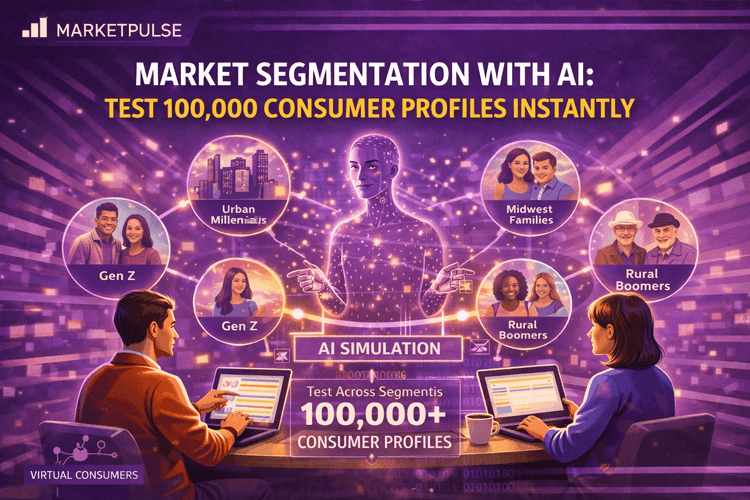
Try market segmentation to find which customer groups care most about price versus convenience.
-
Ask your twin how a new marketing image or tagline lands, the same way you'd run a quick virtual focus group.
-
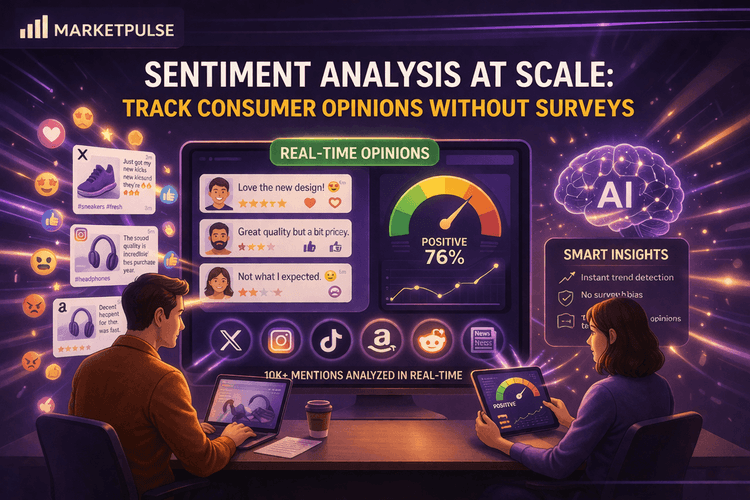
Layer in sentiment analysis from your reviews to understand not just what customers do, but how they feel about it.
Each of these is a small, low-risk way to see what a digital twin can tell you that your CDP never could, and you'll have an answer in minutes, not weeks, the same way teams are getting instant consumer insights and testing ideas at population scale.
FAQs
Is a digital twin the same thing as a CDP?
No. A CDP stores and organizes what customers have already done. A digital twin simulates what they're likely to do next.
Do I need a CDP before I can use DoppelIQ?
Not necessarily. DoppelIQ can start with just customer records and transaction history, though helps you unlock more use cases.
Will this replace our surveys completely?
Not completely, but it can replace most early-stage testing. Save formal surveys for validating big decisions, and use a twin for the fast, cheap testing that comes before that and iterative testing that comes after that to validate your hypothesis against your actual customers.
How accurate are digital twin predictions?
Accuracy depends heavily on how much clean, recent data you feed it. With good first-party data, results are strong, but always ask your provider how they measure and validate accuracy.
Is our customer data safe if we connect it to a digital twin?
With DoppelIQ Enterprise, your data stays encrypted, isolated to your organization, and no personal information is stored once your twin is built.
How long does it take to get started?
Most Enterprise clients start seeing usable insights within a few weeks of connecting their data.
Ready to See What Your Customers Would Actually Say?
You already have the data. DoppelIQ Enterprise turns it into a living model of your real customers, so you can test ideas before you spend a single dollar on them. Sign up free at DoppelIQ and see what your customer data can tell you when you finally get to ask it a question.
Related Articles

How beauty brands use digital customer twins to get insights and win in a competitive segment
 Ankur Mandal
Customer digital twins vs focus groups vs ChatGPT: Concept testing in market research
Ankur Mandal


Population-Scale Consumer Research: How 100,000 AI Twins Beat 1,000 Survey Responses
Nehan Mumtaz
Digital Twin Accuracy: Can AI Really Predict Consumer Behavior? (2026 Benchmark Data)
Nehan Mumtaz
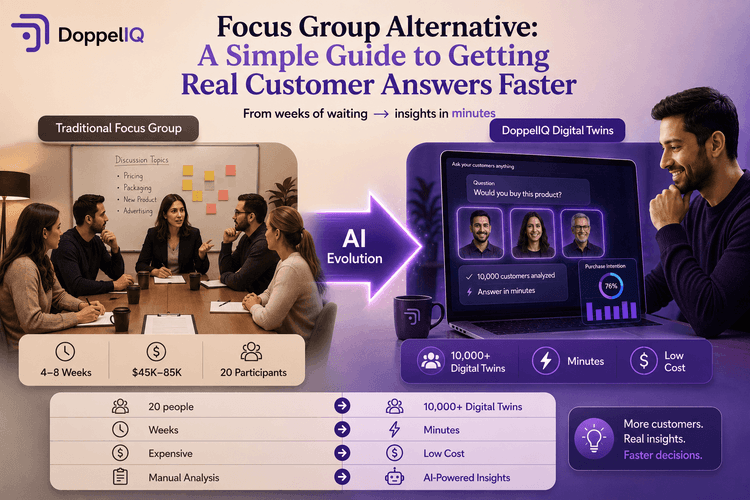
Focus Group Alternative: A Simple Guide to Getting Real Customer Answers Faster
Nehan Mumtaz
Concept Testing Without Surveys: How AI Simulation Unlocks Your Full Product Potential
Nehan Mumtaz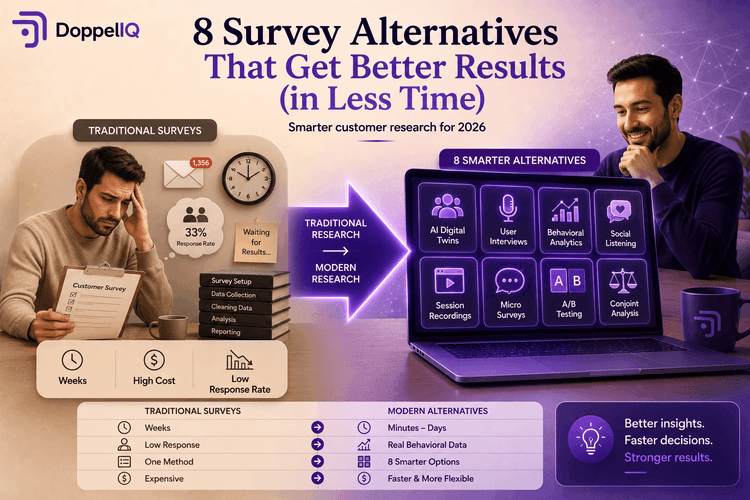
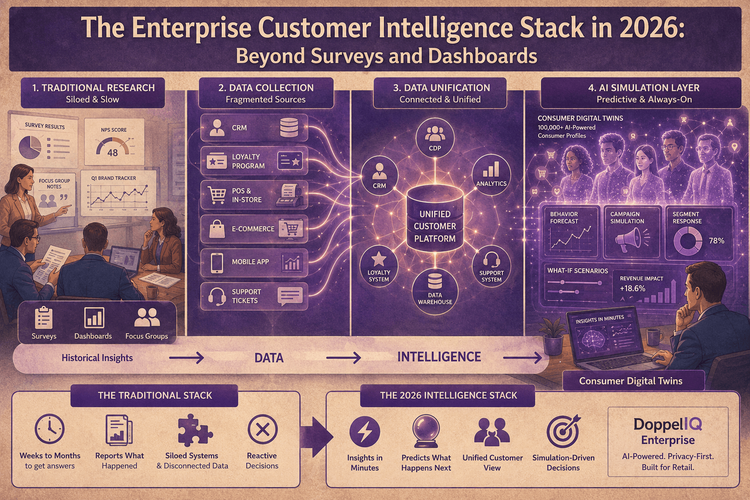
The Enterprise Customer Intelligence Stack in 2026: Beyond Surveys and Dashboards
Nehan Mumtaz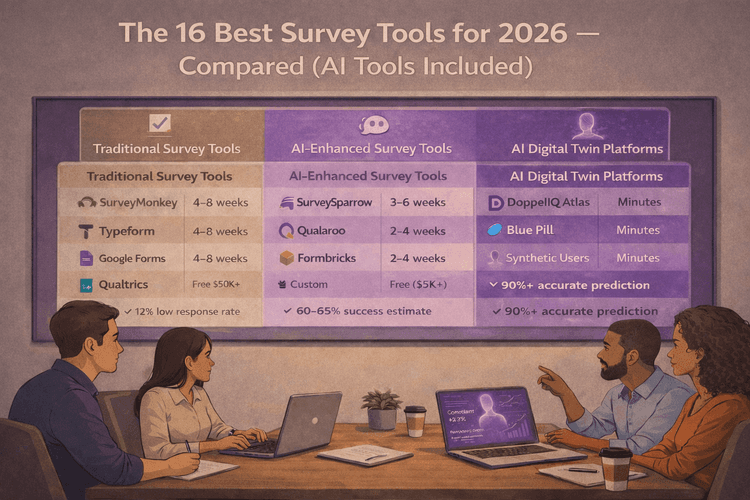
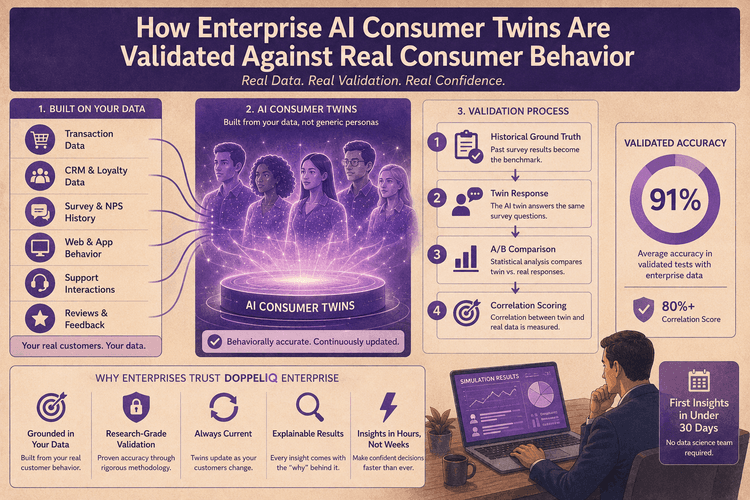
How Enterprise AI Consumer Twins Are Validated Against Real Consumer Behavior
Nehan Mumtaz