
How Much Does a Survey Really Cost? (How to Optimize Survey Budget in 2026)
 Ankur Mandal
You need to know if your new product will work. Or test which ad customers will actually click. So you decide to run a survey.
Then you see the price: $15,000. For one survey. That takes six weeks.
Want to test a different question? Another $15,000.
Need responses from working moms or tech professionals? Add $10,000 more.
Here's the real problem: By the time you get results, your competitor has launched. The trend moved on. Your budget is gone.
What Surveys Actually Cost in 2026
Let’s start with real numbers:
- Online Survey: $5,000 to $15,000+
- Phone Survey: $15,000 to $30,000+
- Mail Survey: $10,000 to $25,000+
- In-Person Survey: $20,000 to $50,000+
- Focus Groups: $7,000 to $20,000+ per group
Source: Drive Research
These are just starting prices. Here’s where your money actually goes.
Cost by buyer type
| Who's Buying | Annual Research Budget | Surveys per Year | The Real Problem |
|---|---|---|---|
| Startup | $10K–$50K | 1–2 | One wrong question = one wasted year |
| SMB | $15K–$75K | 2–3 | 3 shots all year to validate anything |
| Mid-market | $50K–$150K | 4–6 | Still waiting weeks between insights |
| Enterprise | $100K–$500K+ | 8–15 | Multi-market studies, still months-to-results |
Custom market research in 2026 typically costs $25,000–$65,000 per project for a specialist firm , meaning a startup with a $30,000 budget gets exactly one study per year. One chance to ask the right question. (The Farnsworth Group) SUCCESS
The Hidden Costs Nobody Talks About
Think of traditional surveys like throwing a party where you pay every guest to show up, most don’t come, and half who do give fake names.
Finding People (30–40% of cost)
Response rates dropped from 30% in 2010 to just 12% today. That means for every person who completes your survey, eight others ignore it.
And you pay for all of them.
Need specific audiences like doctors or business owners? That's $100 to $300 per response. Need 200 B2B decision-makers? That's $20,000 to $60,000 just for finding people.
Questionnaire design alone runs 40–60 hours of researcher time, adding $8,000–$15,000 before a single response is collected. Programming adds $4,000–$8,000 more. And recruitment typically represents 15–25% of the total project budget , a cost that rarely appears in a headline quote. (MX8 Labs) CX Dive
Paying People to Participate (20–30% of cost)
Nobody takes surveys for free anymore. You're competing with Netflix and TikTok for attention. Typical incentives:
- General consumers: $5–$25
- Professionals: $50–$200
- Hard-to-reach audiences: $300+
The Costs You Don’t See
38% of survey responses have quality issues. People speed through, select random answers, or tell you what you want to hear. That $25,000 survey? About $9,500 is paying for garbage data.
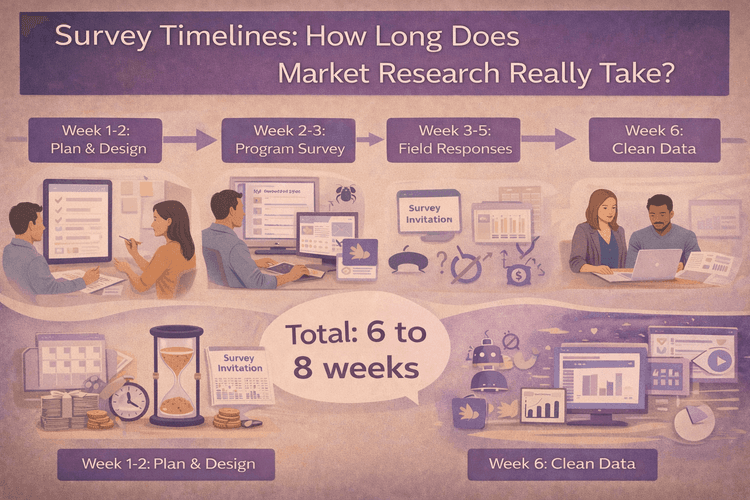
Traditional surveys take 4 to 8 weeks. In that time, your competitor launches, trends shift, and consumer preferences change. A beauty brand once spent $35,000 testing a campaign. Six weeks later, results arrived and the trend had completely shifted. Worthless.
The “One Question” Problem
Every additional question is added costs. One important factor to decide costs of a survey is survey length plus more questions also adds to the response bias if asked together.
The Intention vs. Reality Gap
Here's the biggest problem: people lie. Not on purpose. They just don't know what they'll actually do.
Research shows a 40-50% gap between what people say they'll do and what they actually do. They say they'll buy healthy options, then buy cookies. They say price doesn't matter, then pick the cheapest one.
You're spending $25,000 to measure intentions, not behavior.
The cost nobody counts: launching without data
75% of consumer packaged goods fail to earn even $7.5 million in their first year. Nearly half of all product launches miss their mark , with poor market research and unclear customer targeting cited as the primary causes. (Harvard Business Review via shno.co) Rajivgopinath
A study analysing £5 billion in ad spend found that 70% of advertising campaigns fail to deliver a meaningful return on investment. (MagicLogix) iFactory
A $25,000 survey feels expensive. A failed product launch , $500,000 to develop, $200,000 to market, zero consumer validation , costs 28x more. The survey was never the expensive option.
Real Examples of Survey Costs
Basic Customer Satisfaction Survey
- 500 responses, general population
- 15 questions, 5 minutes
- Cost: $8,000–$12,000
- Timeline: 3–4 weeks
Brand Perception Study
- 1,000 responses with age/income quotas
- 25 questions, 10 minutes
- Cost: $15,000–$25,000
- Timeline: 5–6 weeks
B2B Research
- 200 responses from specific job titles
- Cost: $25,000–$45,000
- Timeline: 6–8 weeks
Qualitative / In-Depth Interviews (IDIs)**
- 20 interviews, professional moderator, full transcription and analysis
- Cost: $15,000–$30,000
- Timeline: 4–8 weeks
A 200-interview AI-moderated study delivers comparable qualitative depth in 48–72 hours at roughly $4,000 all-in — including recruitment, incentives, transcription, and automated analysis. (User Intuition) Greenbook
If your annual budget is $100,000, you're looking at maybe 3-4 major projects. Three chances to ask the right questions all year.
What If You Could Test 100 Ideas for the Price of One?
This is where consumer AI digital twins change everything.
Traditional surveys are like calling random people and asking questions. AI digital twins are like having 100,000 realistic profiles, each programmed to think and behave like a real American consumer, that you can ask anything, anytime.
Except these aren't made up. They're built from real data about real people.
Meet DoppelIQ Atlas
DoppelIQ Atlas has 100,000 pre-built consumer profiles representing the entire US population.
- Demographics (age, income, location, family)
- Psychographics (values, attitudes, lifestyle)
- Professional information
- Media habits and preferences
- Purchase behaviors
Here's what makes it different from AI chatbot tools: Atlas is built on actual survey data from real Americans, demographic distributions, and behavioral datasets. It's not making up answers. It simulates how real consumers actually behave based on proven patterns.
How It Actually Works
Step 1: Ask a question in normal English "Would young professionals in major cities pay $8 for a sustainable coffee pod versus $5 for a regular one?"
Step 2: Responses Shaped by a Unique Digital Persona Every digital twin answers based on their specific and exclusive persona so that the answers are unique and grounded in reality.
Step 3: Get results in minutes Not weeks. Minutes.
You see how different groups respond, their concerns, what would change their minds, which segments love versus hate your idea.
Step 4: Test unlimited variations instantly Testing out product feature? Test different messaging? Try a completely different angle?
You don't need a new $15,000 survey. Just ask another question. Right now. For free.
This breaks the traditional model: unlimited scenarios at no additional cost.
Cost Comparison
| Traditional Surveys | DoppelIQ Atlas | |
|---|---|---|
| Annual Cost | $100,000 (4 surveys @ $25K each) | $500 (For 4 surveys) |
| Time to Insights | 4–8 weeks per survey | Minutes |
| Scenarios Tested | 4 per year | Unlimited |
| Cost Per Insight | $25,000 | Starts at $99 (For a 500 respondent survey) |
| Response Rate | 12% (88% ignore your survey) | 100% (no survey fatigue) |
| Data Quality Issues | 38% of responses | Consistent behavioral simulation |
| Flexibility | Each new question = new $25K project | Ask follow-ups instantly for free |
| Accuracy | 40–50% intention–behavior gap | 91% correlation with real outcomes |
| Qualitative depth | IDIs at $500–$1,500 per interview | Conversational querying across 100,000 profiles , no per-interview cost |
AI-moderated qualitative interviews now deliver comparable depth to traditional IDIs at 80–93% lower cost. (Merren.io) Greenbook
With traditional surveys at $100,000/year, you test 4 things. That's $25,000 per insight.
With Atlas at $500 for 4 surveys, you can achieve 100% response rate, accurate behavioural responses, no bias and zero incentives needed.
That's a 99% cost reduction per scenario.
Real Use Cases
- Explore New Markets: Simulate responses across 100,000 twins segmented by demography, occupation, and aspirations.
- Test Campaigns Instantly: See how diverse populations react before you launch, without waiting weeks for surveys.
- Spot Emerging Signals: Detect shifts in consumer mindset, preferences, and motivations early.
- Validate Big Bets: Stress-test new products or categories with confidence using real-world data–grounded twins.
All of this at a fraction of a cost which makes it repeatable, till you optimize your strategy.
Does This Actually Work?
91% correlation with real consumer survey outcomes. That's validated, tested, proven accuracy.
Compare that to traditional surveys where: -38% of responses have quality issues -40-50% of stated intentions don't match actual behavior -88% of people contacted never respond
Atlas simulates actual behavior. Traditional surveys ask what people might do someday.
What AI Digital Twins Can’t Do
Atlas is powerful, but not magic. Traditional research still makes sense for:
- Brand new categories with no precedent (like the first iPhone)
- Ultra-specific niche audiences not represented in population data
- When stakeholders require traditional methodology (regulatory, legal)
The smart approach? Use Atlas to test 20 concepts, narrow to your top 2-3, then validate with traditional research if needed.
You just saved $250,000 and six months.
How to Optimize Your 2026 Research Budget
Whether you stick with traditional or explore AI digital twins, here's how to get more from your budget:
If Sticking with Traditional Surveys
- Keep surveys short: Every extra question increases dropout and cost
- Use quota sampling smartly: Representative samples are expensive
- Negotiate panel pricing: Volume discounts exist
- DIY simple surveys: Use SurveyMonkey or Typeform for basic questions
- Front-load quality checks: Catch bad data early
If Exploring AI digital twins
- Start with quick wins: Test messaging
- Run parallel validation: Test the same question on Atlas and traditional survey to build confidence
- Use unlimited testing strategically: Test 50 times, learn constantly
- Train teams to think differently: Ask "which of these 10 works best?" instead of "would this work?"
Smart Budget Allocation
Here's how a $100,000 annual research budget compares:
| Budget Allocation | What You Get | |
|---|---|---|
| Traditional Model | $100,000 ÷ $25,000 = 4 projects |
|
| Optimized 2026 Model | $500-$1000 (Atlas) |
|
The difference: You're not choosing between cost and quality. You're choosing between 4 research projects per year or 400.
The Real Question
Yes, traditional surveys cost $5,000 to $50,000+ per project in 2026.
But that's not the right question anymore.
The right question is: "How much is NOT having insights costing you?"
Every product launched without testing. Every campaign based on guesswork. Every pricing decision from gut feel. Those all cost money. Usually more than research.
Consumer AI digital twins don't cut corners. They fundamentally change the economics of research. In 2026, testing one idea for $25,000 over six weeks makes as much sense as faxing your team a memo.
Frequently Asked Questions
How much does a basic online survey cost?
A basic online survey costs $5,000 to $15,000, while more complex surveys with specific audiences can run $25,000 to $50,000+.
Why are surveys so expensive?
You're paying for low response rates (only 12% respond), incentives for participants, poor data quality (38% have issues), agency fees, and weeks of waiting time.
How long do surveys take?
Traditional surveys take 4 to 8 weeks from start to finish. AI digital twin platforms like DoppelIQ Atlas deliver results in minutes.
What’s the difference between AI personas and AI digital twins?
AI personas are fictional characters. AI digital twins are behavioral simulations built on real data from 100,000 US consumers with 83% proven accuracy.
Can AI digital twins replace all traditional surveys?
Not entirely. Use AI digital twins to test many options quickly, then validate finalists with traditional research if needed for regulatory or stakeholder requirements.
How accurate are consumer AI digital twins?
DoppelIQ Atlas shows 83% correlation with real survey outcomes, which is more reliable than traditional surveys where 40-50% of stated intentions don't match actual behavior.
Do I need technical skills to use AI digital twin platforms?
No. DoppelIQ Atlas works with normal conversational language and it can be used by anyone, marketing customer insights, research teams.
How many surveys can I run with AI Digital twin platform?
With DoppelIQ Atlas, for the same costs of a traditional survey, you can run around 250 surveys. 250 surveys each for 100$
Ready to Test Your Next Idea in Minutes?
Try DoppelIQ Atlas free. Access 100,000 US consumer AI digital twins and get your first insights today. No credit card required.
Ask any question you'd ask in market research. Test any concept you've been wondering about. See how different consumer groups respond.
The first survey might answer a question you've had for months. The tenth might discover an opportunity you never considered. The hundredth might transform how your team makes decisions. And it costs less than a single traditional survey.
Want to see how DoppelIQ compares to other platforms? Check our detailed comparison of the top 12 solutions.
Or learn more about how AI digital twin technology works and why it's changing consumer research forever.
Related Articles

How beauty brands use digital customer twins to get insights and win in a competitive segment
Ankur Mandal
Customer digital twins vs focus groups vs ChatGPT: Concept testing in market research
Ankur Mandal
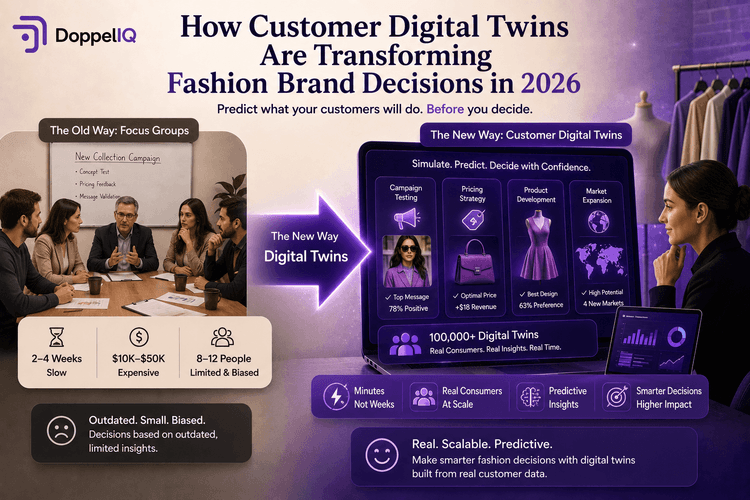


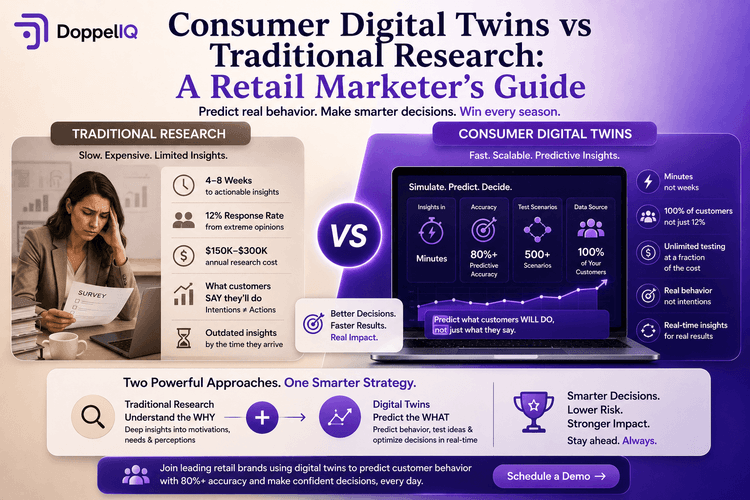
Population-Scale Consumer Research: How 100,000 AI Twins Beat 1,000 Survey Responses
 Nehan Mumtaz
Digital Twin Accuracy: Can AI Really Predict Consumer Behavior? (2026 Benchmark Data)
Nehan Mumtaz
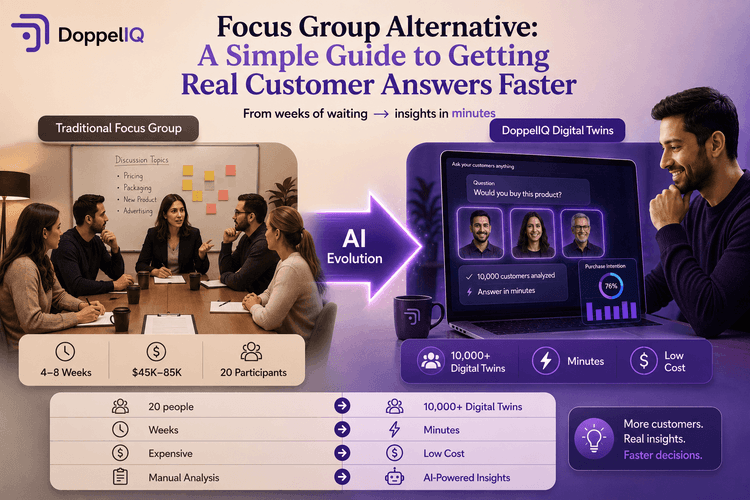
Focus Group Alternative: A Simple Guide to Getting Real Customer Answers Faster
Nehan Mumtaz
Concept Testing Without Surveys: How AI Simulation Unlocks Your Full Product Potential
Nehan Mumtaz
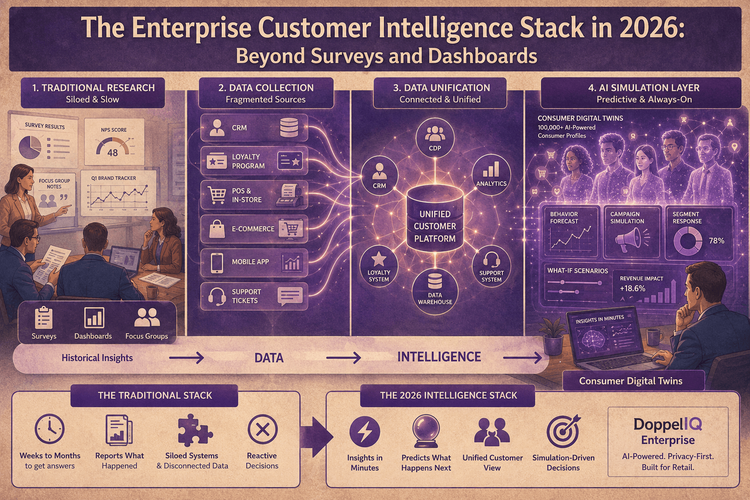
The Enterprise Customer Intelligence Stack in 2026: Beyond Surveys and Dashboards
Nehan Mumtaz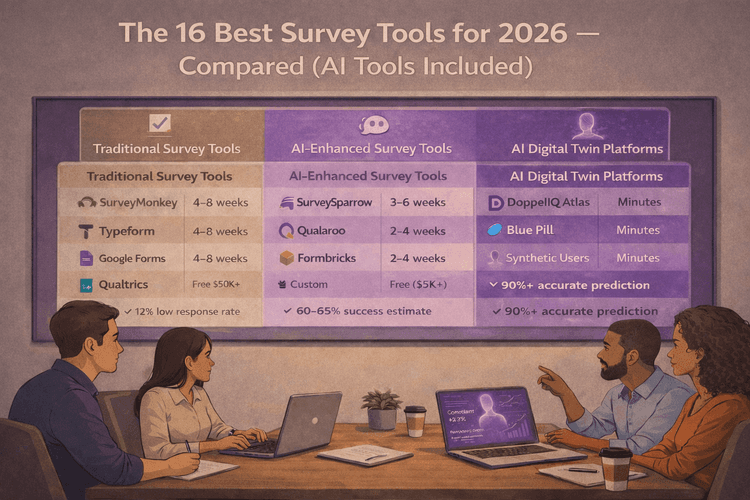
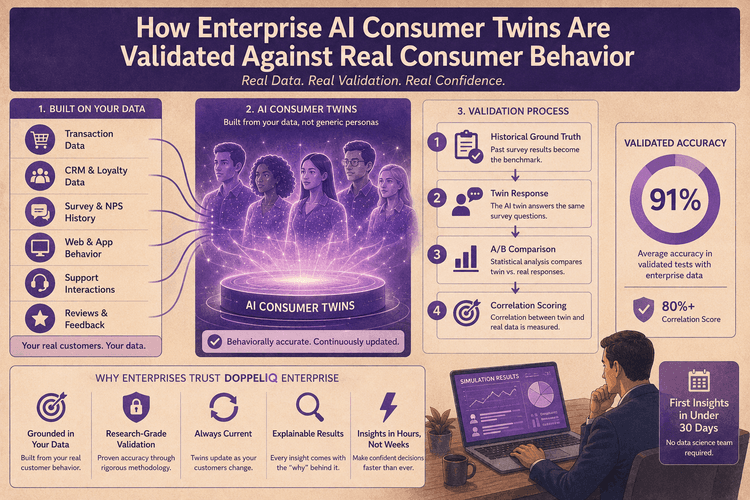
How Enterprise AI Consumer Twins Are Validated Against Real Consumer Behavior
Nehan Mumtaz