
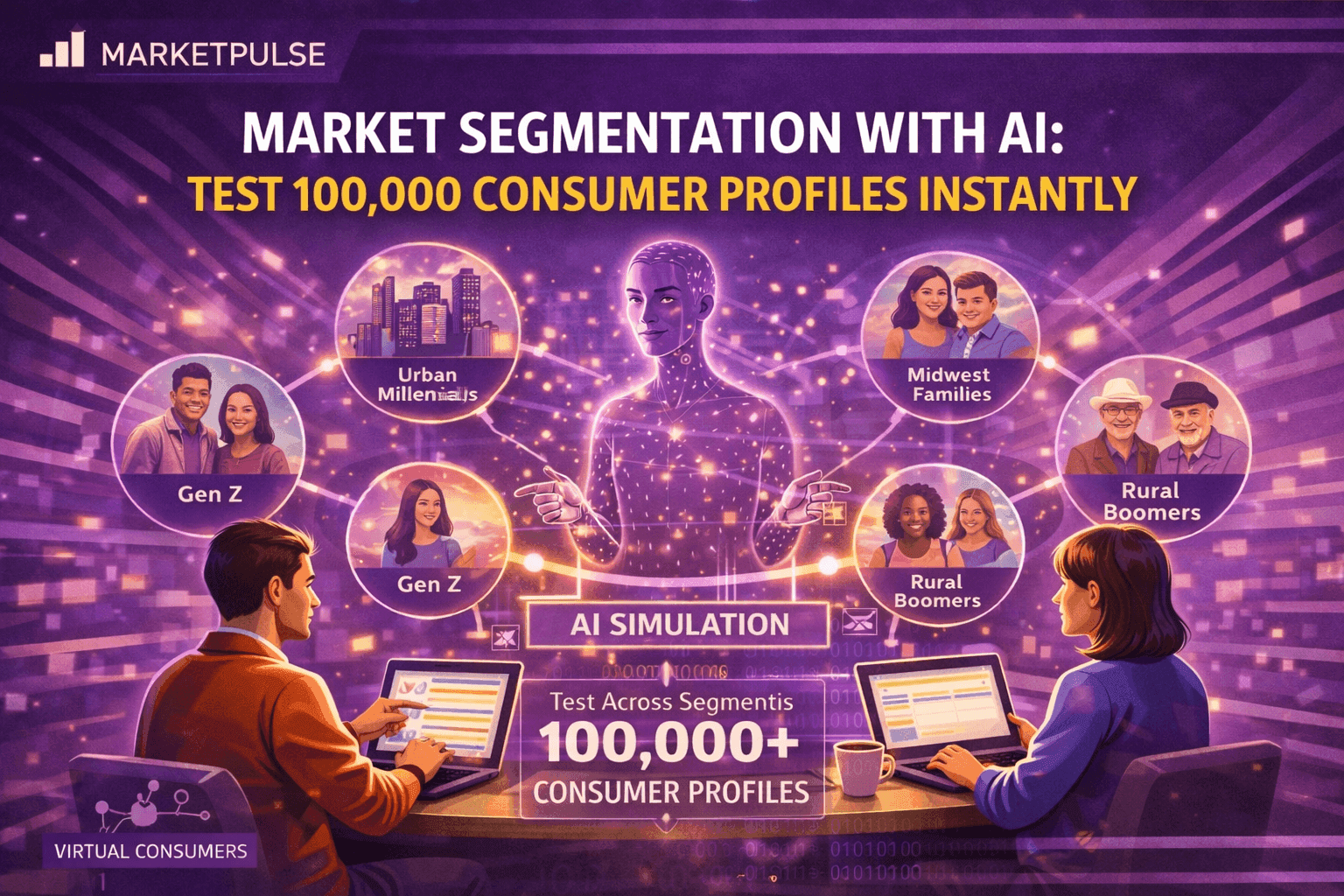
Market Segmentation with AI: Test 100,000 Consumer Profiles Instantly
 Nehan Mumtaz
Think about how a good store manager knows their customers. They know that the mom shopping at 9 am on a Tuesday is not the same person as the college student browsing on a Friday night. They talk to them differently, stock shelves differently, and run promotions differently. That is segmentation in action.
Now imagine you could do that for 100,000 shoppers at once, and get answers back in minutes. No surveys. No waiting weeks. No guessing.
That is exactly what AI-powered market segmentation makes possible today. And with tools like DoppelIQ Atlas, you do not need a data science team or a big budget to get started.
What Is Market Segmentation (and Why Should You Care)?
Market segmentation is the practice of dividing your customers into groups based on what they have in common, so you can speak to each group more directly. Instead of sending the same message to everyone, you figure out who is who and what they actually want.
The four classic ways retailers segment their audience are:
| Type | What It Means | Example |
|---|---|---|
| Demographic | Age, income, gender, education | Women aged 25–40 earning $60k+ |
| Behavioral | How they shop, buy, and use products | Frequent buyers who return items often |
| Psychographic | Values, lifestyle, personality | Eco-conscious shoppers who prefer sustainable brands |
| Geographic | Where they live | Urban shoppers vs. suburban families |
Good segmentation helps you run better promotions, write ads that actually resonate, price your products smarter, and launch new items with confidence. It is the backbone of audience targeting and consumer segmentation.
Why Traditional Personas Break at Scale
Most marketing teams build customer personas. You have probably seen them. They look something like this: "Meet Sarah. She is 34, loves yoga, shops online, and is price-conscious."
The problem is that Sarah is made up. She is an average of thousands of real people, and averages hide the truth.
Here is a simple way to think about it. Imagine you want to know the average temperature in the US so you can decide what to sell in your stores. The average might be 65 degrees. But that number is useless if you are trying to decide whether to stock winter coats or swimsuits. You need to know what is happening in each region, not the average of everything.
Personas do the same thing to your customers. They collapse real differences into one tidy description that ends up being accurate for almost nobody.
There are two specific ways this hurts you:
• Personas freeze behavior in time. A persona built in 2022 does not know that your customers shifted their priorities after inflation hit. Static descriptions do not update. Real people do.
• Personas hide important differences within each group. Even within one segment, some people will respond completely differently to a price change, a new product, or a marketing message. You only find that out when you look at individual-level behavior at scale.
Segmentation Should Predict Behavior, Not Just Describe People
Here is a test for any segment you have ever built: does it tell you how people will actually react?
A segment is only useful if it predicts behavior. Knowing that a group is "millennial women who shop online" is a starting point. But what you really need to know is: will this group buy the new product at this price? Will they respond to this ad? Will they churn if you raise prices by 10%?
This is where traditional segmentation falls short. And it is why the field has been moving toward behavioral segmentation and predictive analytics. The goal is not just to describe who your customers are. The goal is to predict what they will do.
If you want a deeper look at why traditional research methods struggle to answer these questions, check out this comparison of consumer research solutions in 2025.
How AI Changes the Game
AI does not just make segmentation faster. It makes it fundamentally different in three ways.
1. It handles more variables at once
A human analyst can keep track of maybe 5 to 10 variables when building segments. AI can process hundreds of variables simultaneously, including age, income, purchase history, lifestyle signals, media habits, and more, and find patterns that no human would spot.
2. It works at population scale
Instead of studying a sample of 500 people and hoping it represents everyone, AI can simulate entire populations. You can observe how different types of consumers respond to your ideas, not just guess based on a small group.
3. It is fast
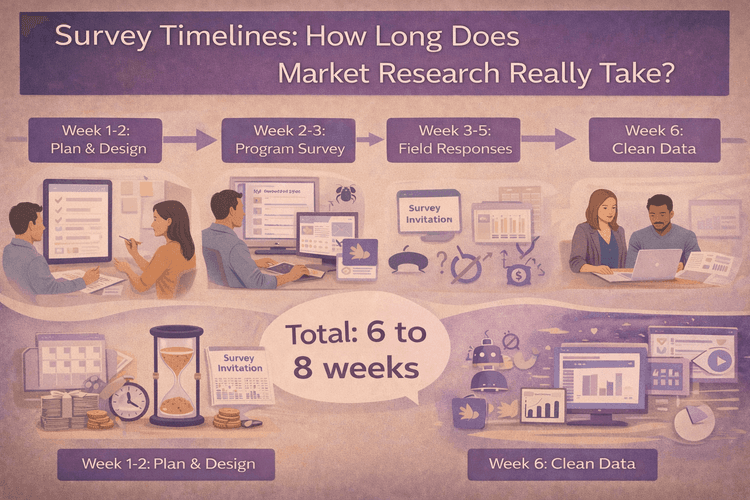
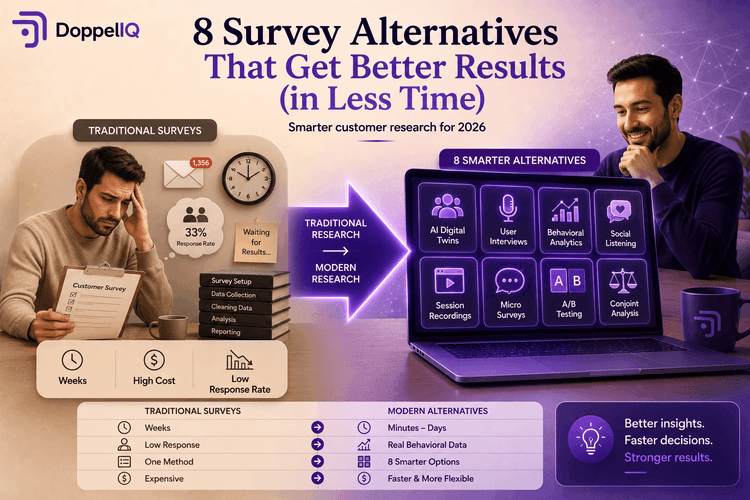
Traditional survey timelines can stretch to weeks or months. AI delivers insights in minutes. If you are curious why surveys take so long in the first place, that link breaks it down clearly.
The Problem with Surveys (and Why AI Twins Solve It)
Most retailers have run surveys at some point. And most have been frustrated with them. Survey response rates have been dropping for years. People rush through them, skip questions, or give answers that sound good rather than answers that are true.
This is called survey bias, and it quietly ruins your data. On top of that, running a proper survey is expensive. Recruitment, incentives, analysis, and reporting add up fast.
That is why many teams are now exploring survey alternatives that get better results. One of the most powerful alternatives is the AI consumer digital twin.
What Is an AI Consumer Digital Twin?
Think of it like a flight simulator for your marketing decisions. Pilots train in simulators before flying real planes because simulators let them test every scenario without any real-world risk. An AI consumer digital twin does the same thing for your campaigns, products, and pricing.
Instead of asking real people questions and waiting for answers, you query a digital model of a consumer. That model is built from real survey data, behavioral patterns, demographics, and psychographics. It responds the way a real person matching that profile would.
Unlike AI personas (which are basically ChatGPT making up a fictional character), digital twins are grounded in real population data. The difference matters a lot. Learn more about how digital twin technology works for consumer research.
Introducing DoppelIQ Atlas: 100,000 Consumer Profiles, Ready Right Now
DoppelIQ Atlas is a prebuilt, population-scale AI consumer panel for the US market. It contains 100,000 synthetic consumer profiles, each representing a real type of American consumer based on:
• Demographic distributions (age, income, geography, education)
• Psychographic patterns (values, motivations, lifestyle)
• Professional profiles (occupation, income bracket, industry)
• Media and lifestyle signals (what they watch, read, and respond to)
Here is what makes it different from anything else on the market:
| Feature | Traditional Survey | AI Personas | DoppelIQ Atlas |
|---|---|---|---|
| Based on real data | Yes (small sample) | No | Yes (national scale) |
| Time to insights | Weeks to months | Minutes | Minutes |
| Sample size | 200–1,000 people | 5–10 personas | 100,000 profiles |
| Bias risk | High | Very high | Low |
| Cost | High | Low | Low |
| No data setup needed | No | No | Yes |
You do not need to bring any data. You do not need a data science team. You sign up, and within minutes you are asking questions in plain English and getting answers back.
And because Atlas carries ~91% correlation with real US consumer survey outcomes, it is not just fast. It is accurate. See the research on how accurately AI can predict consumer behavior.
How Retail Marketers Actually Use Atlas
Here are four real use cases that retail and CPG teams run every week:
Testing a New Product Before Launch
Instead of building a prototype and running concept testing with expensive surveys, you ask Atlas directly. "How would suburban families earning $75,000 to $100,000 respond to a plant-based protein snack at $4.99?" You get segment-level responses in minutes, not months.
Message Testing Before Ad Spend
You have two headlines. You want to know which one will land better with Gen Z shoppers in the Southeast. Ask Atlas. You will see not just which wins, but why, broken down by values, motivations, and lifestyle.
Spotting Emerging Trends
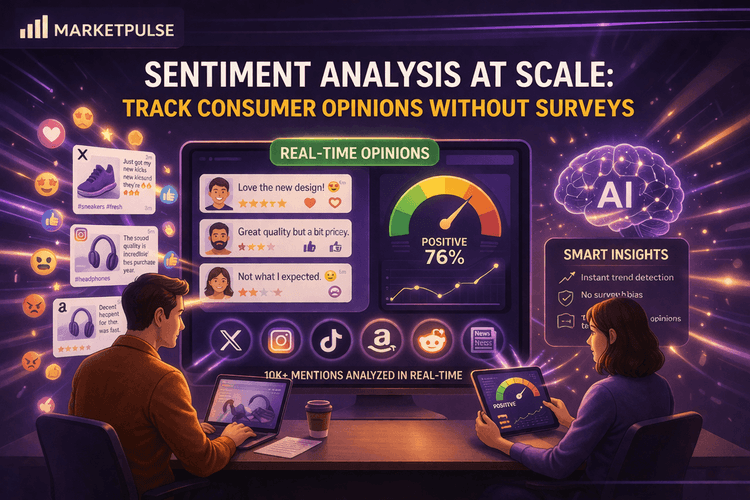
Because Atlas is grounded in national survey benchmarks, you can detect shifts in consumer mindset before they show up in your sales data. Think of it as an early warning system for your category.
Segmenting a Market You Have Never Entered
Exploring a new region or demographic you have no data on? Atlas already has them. This is one of the biggest advantages of population-scale consumer research, you are not limited to the customers you already have.
From Static Segments to Living, Testable Populations
The real shift that AI brings to market segmentation is not just speed. It is the move from describing your audience to testing them.
Old segmentation says: "Our target is women 25-45 who value convenience."
New segmentation says: "Here is how 12,000 women aged 25-45 who value convenience responded to three different price points for our new product. Segment B had 3x the intent to purchase at $14.99 versus $19.99. Segment C showed strong interest but only in sustainable packaging variants."
That is the difference between a description and an insight. And it is why instant consumer insights are becoming the new standard for fast-moving retail and consumer brands.
This is also the future of synthetic respondents in market research. The shift is already underway.
Quick Comparison: Segmentation Approaches
| Approach | Speed | Accuracy | Scale | Cost |
|---|---|---|---|---|
| Focus groups | Slow (weeks) | Medium | 10–20 people | Very high |
| Online surveys | Medium (days/weeks) | Medium | 200–1,000 | High |
| AI personas | Fast | Low (not data-grounded) | 5–10 profiles | Low |
| DoppelIQ Atlas | Instant (minutes) | High (~91% correlation) | 100,000 profiles | Low |
Frequently Asked Questions
What is market segmentation in simple terms?
It is splitting your customers into groups so you can talk to each group in a way that actually makes sense for them, rather than sending one message to everyone.
How is AI segmentation different from regular segmentation?
Regular segmentation uses a small sample and creates a few broad groups. AI segmentation can process hundreds of variables across thousands or even hundreds of thousands of consumer profiles to find more precise, accurate groups.
What is a consumer digital twin?
It is a synthetic model of a real consumer type, built from actual population data. You can ask it questions just like you would ask a real survey respondent. Read the full guide here.
Do I need any data to use DoppelIQ Atlas?
No. Atlas comes preloaded with 100,000 US consumer profiles. You sign up and start asking questions immediately.
How accurate is DoppelIQ Atlas?
Atlas shows approximately 91% correlation with real US consumer survey outcomes. See how that benchmark was measured.
Can non-technical marketing teams use this?
Yes. You query Atlas in plain conversational English. No coding, no data science, no complex setup required.
How is Atlas different from AI personas?
AI personas are fictional characters created by a language model with no real data behind them. Atlas profiles are grounded in national-level survey data, behavioral datasets, and demographic distributions. The difference is like asking a made-up character versus interviewing a real person.
How often does Atlas update?
Atlas updates annually based on new US consumer survey benchmarks, so it stays aligned with how real American consumers are thinking and behaving today.
What kinds of questions can I ask Atlas?
Any question you would ask in a consumer interview or survey. "Which of these packaging options appeals most to retirees?" or "Would young professionals in Chicago pay more for a subscription version of this product?" You ask it in natural language and get answers back fast.
Is this better than running a survey?
For most exploratory and pre-launch research, yes. It is faster, cheaper, and avoids the bias problems that plague traditional surveys. For very high-stakes decisions, you can use Atlas to refine your questions and then validate with a targeted real-world survey.
Ready to Stop Guessing and Start Testing?
Stop building personas that become outdated in six months. Stop running surveys that take weeks and return biased data. Start querying 100,000 real American consumer profiles in minutes, in plain English, with no setup required.
DoppelIQ Atlas gives your marketing, product, and insights teams the power to test ideas before spending a dollar on ads or production. Sign up free and run your first consumer simulation today at doppeliq.ai.
Related Articles

How beauty brands use digital customer twins to get insights and win in a competitive segment
 Ankur Mandal
Customer digital twins vs focus groups vs ChatGPT: Concept testing in market research
Ankur Mandal


Population-Scale Consumer Research: How 100,000 AI Twins Beat 1,000 Survey Responses
Nehan Mumtaz
Digital Twin Accuracy: Can AI Really Predict Consumer Behavior? (2026 Benchmark Data)
Nehan Mumtaz
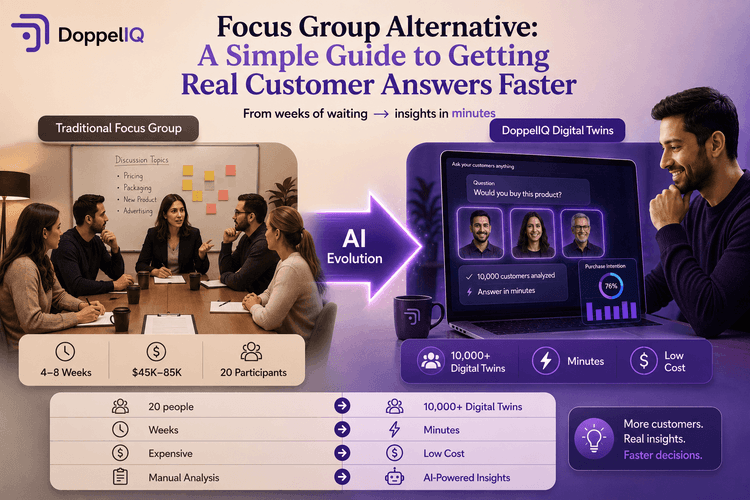
Focus Group Alternative: A Simple Guide to Getting Real Customer Answers Faster
Nehan Mumtaz
Concept Testing Without Surveys: How AI Simulation Unlocks Your Full Product Potential
Nehan Mumtaz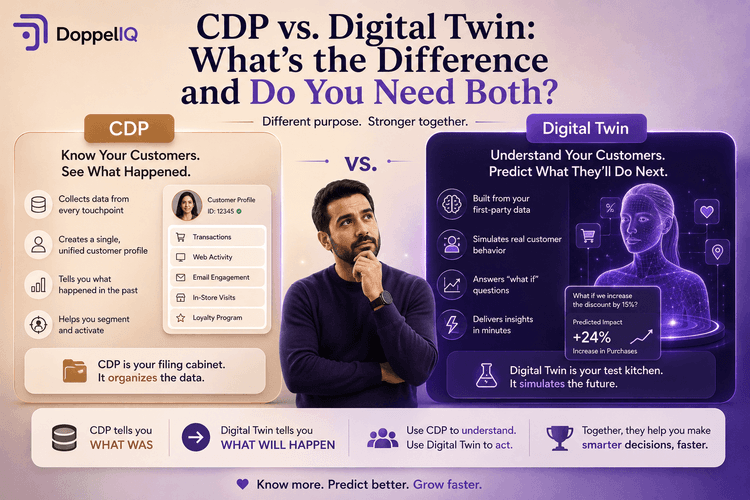
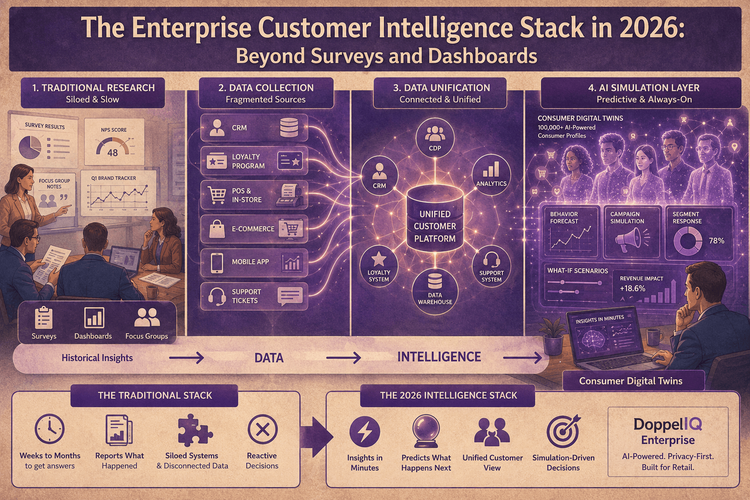
The Enterprise Customer Intelligence Stack in 2026: Beyond Surveys and Dashboards
Nehan Mumtaz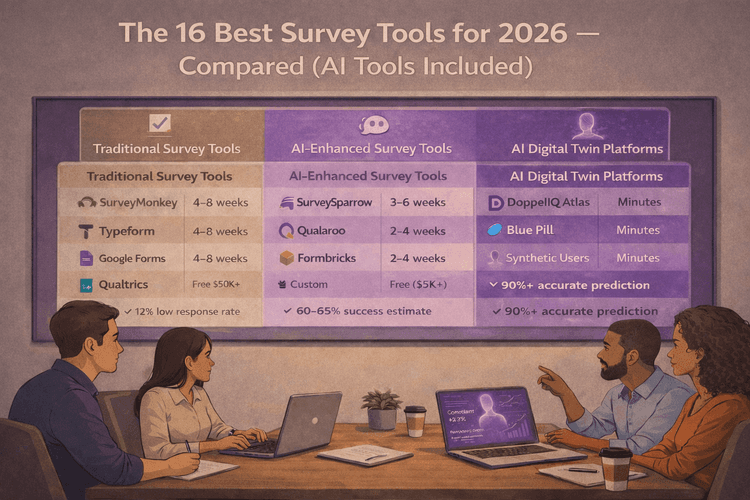
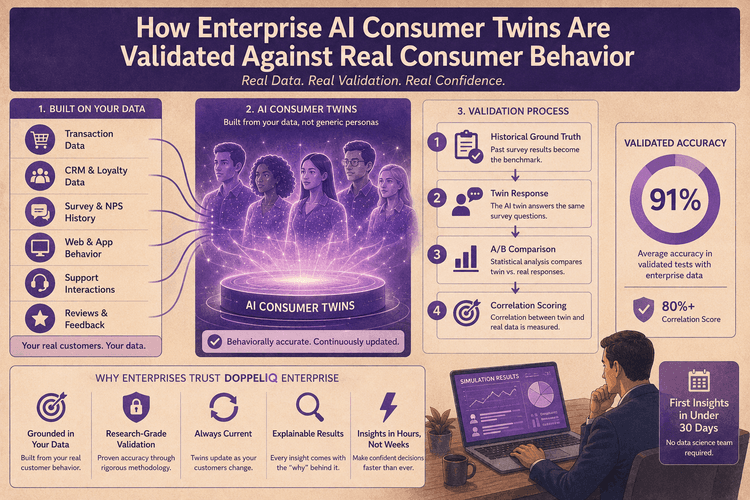
How Enterprise AI Consumer Twins Are Validated Against Real Consumer Behavior
Nehan Mumtaz