
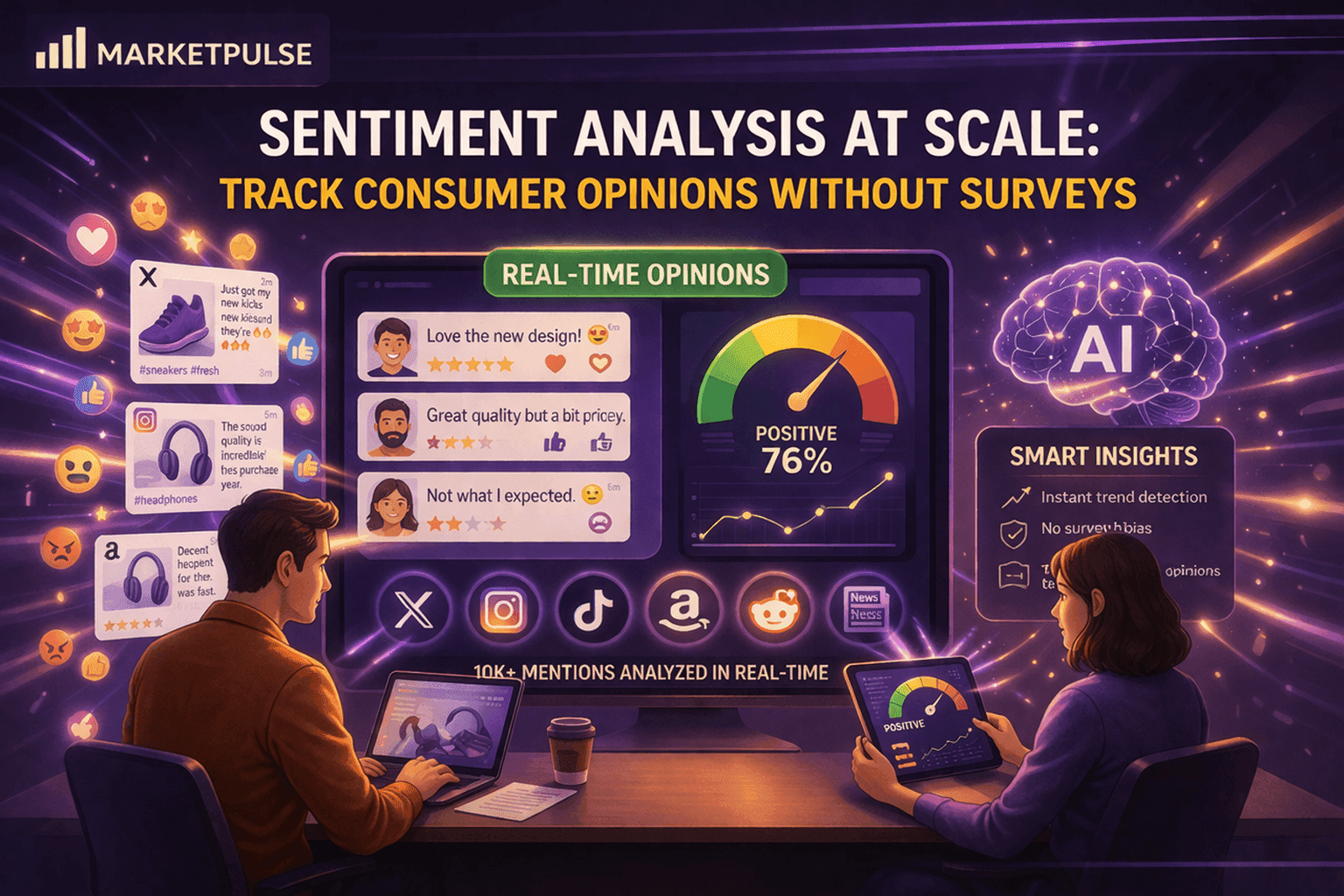
Sentiment Analysis at Scale: Track Consumer Opinions Without Surveys
 Nehan Mumtaz
You launch a new flavor. You change the price. You run a campaign. And then you wait -- checking dashboards, watching sales, hoping it worked.
Most brands are flying blind until something goes wrong. This article explains why that happens, what sentiment analysis can and cannot do, and how AI Consumer Digital Twins, specifically DoppelIQ Atlas, let you see how shoppers will react before you spend a dollar.
What Is Sentiment Analysis?
Sentiment analysis is the process of figuring out how people feel about something based on what they write or say. Think of it like a teacher reading 1,000 student surveys and sorting them into "happy," "frustrated," or "neutral" piles, but done automatically by software, in seconds.
For retail and consumer brands, sentiment analysis usually means scanning product reviews, social media posts, and customer service messages to figure out how shoppers feel about your brand, product, or campaign.
That is useful. But it only tells you what already happened, based on what people chose to post publicly. And that is where the trouble starts. If you want a deep look at the research tools available today, check out this comparison of best consumer research solutions in 2025.
The Problem: Social Listening Only Shows You Part of the Picture
Social listening is the most common way brands do sentiment analysis at scale. You plug in some keywords, track mentions across Instagram, Reddit, and X (Twitter), and get a sentiment score. Simple enough.
But here is the problem. Think about a movie theater. The people who post Yelp reviews are not the average moviegoer. They are either really happy or really angry. The person who had a fine Tuesday evening and went home? They never wrote a word.
That is exactly what happens with social listening for your brand.
The 3 Big Limits of Social Listening
| The Limit | What It Means for You |
|---|---|
| Only captures public posts | The silent majority, your biggest buyer group, never shows up in the data |
| Biased toward extreme opinions | Angry and excited shoppers post. Satisfied ones don’t. Your scores skew negative |
| Shows past reactions only | You only learn how people felt about what already happened, never what comes next |
There is also a built-in skew toward negative feedback. People post when they are angry far more than when they are satisfied. A product with 10,000 happy customers and 80 frustrated ones will look troubled in a standard social listening report. That is not a bug in the tool. It is a structural feature of how social media works.
Why More Mentions Does Not Mean Better Sentiment
Here is a mistake we see all the time: a brand sees their product trending on social media and assumes that means good news.
It does not.
Imagine a grocery store putting up a giant sign that says "Try our new store brand chips!" Thousands of people look at the sign. But if the chips taste bad, all those eyeballs do not help. Volume and sentiment are two completely different things.
• High mention volume can mean a controversy is brewing, not a fan club forming.
• Low mention volume does not mean low impact, your most loyal, high-spending customers rarely post on social media.
• A net sentiment score of "+40" means nothing if your best customers are at "-10" and your casual shoppers are at "+70."
- The Brand with the loudest social presence is not always the one with happiest customers.
- The Brand that understands how much each segment feels--not just how loud they are--is the one making smarter decisions.
Real insight comes from understanding how different groups of shoppers feel, not just how many people are talking. A single number for your whole customer base is like averaging the temperatures in Miami and Minneapolis and calling it comfortable.
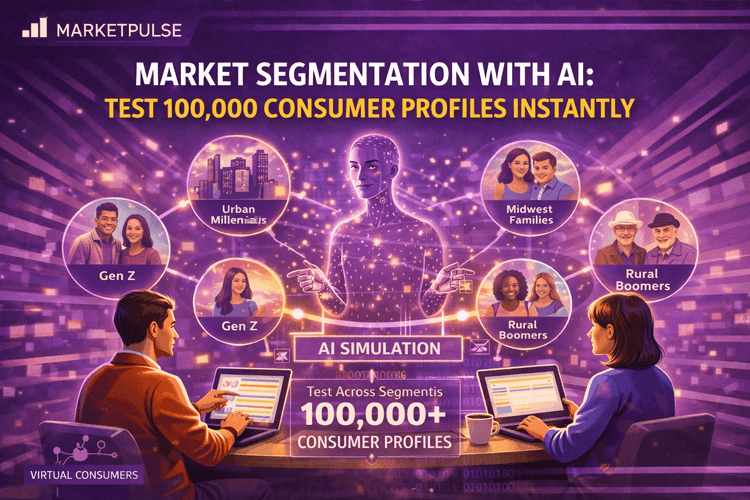
Learn more about how market segmentation with AI gives you a cleaner read on what each group actually thinks.
Predictive Sentiment: Knowing How Shoppers Will React Before You Launch
This is where things get really useful for brand managers.
Predictive sentiment is not about reading what people already said. It is about simulating what people would say about something that has not happened yet.
Think of it like a flight simulator. Pilots train in simulators before flying real planes. They can crash 50 times, learn from each one, and never put a single passenger at risk. Predictive sentiment does the same thing for your brand decisions.
Instead of launching a campaign and hoping, you simulate consumer reactions first. You test three different price points. You try two packaging designs. You see which headline resonates with moms in the Midwest before your creative agency bills you for revisions.
This is a big part of why brands are moving toward, the old way is simply too slow.
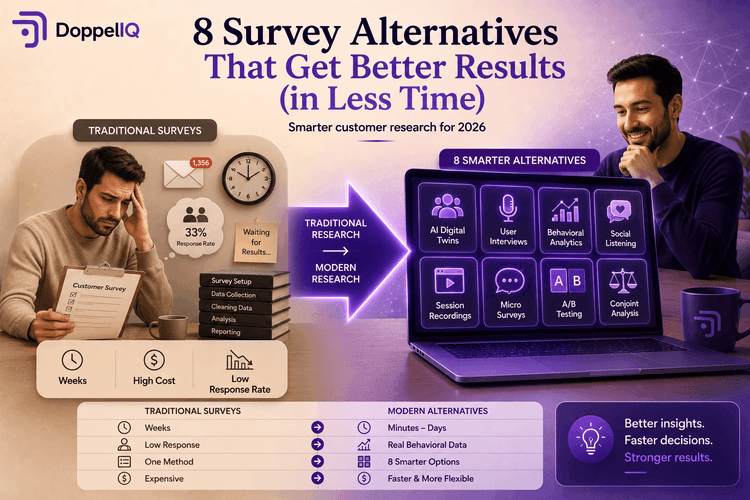
Traditional surveys can take weeks to complete and still come back with biased answers and are real blockers, and even when you finish, .
| Method | Time to Insight | Can Test Future Scenarios? |
|---|---|---|
| Social listening | Real-time | No |
| Traditional survey | 2 to 6 weeks | Partially |
| Predictive simulation (Atlas) | Minutes | Yes |
DoppelIQ Atlas: Sentiment Across 100,000 Shoppers, Instantly
DoppelIQ Atlas is a pre-built panel of 100,000+ AI Consumer Digital Twins, trained on real US national survey data, behavioral datasets, psychographics, and demographic distributions. You do not upload any data. You do not need a data team. You just ask your question in plain English and get answers.
It is like having a research firm on standby 24 hours a day, except the results come back in minutes, not months.
How It Is Different from Social Listening and AI Personas
Atlas is not a monitoring tool. It does not scrape social media. It also is not a chatbot you configure with a fake persona. It is a population model, meaning it mirrors the actual spread of US consumers across age, income, occupation, lifestyle, and mindset.
This is what makes it different from other survey alternatives, Atlas gives you population-level answers, not one fictional character's opinion
The accuracy benchmark matters too. Atlas shows approximately 91% correlation with real US consumer survey outcomes. For context, that is within the normal range of traditional surveys, which suffer from respondent bias, fatigue, and slow fielding anyway. More on how this compares: can AI really predict consumer behavior?
What You Can Ask Atlas
• "How do suburban moms feel about our new protein bar packaging?"
• "Would young professionals pay more for a sustainable version of our product?"
• "Which of these three campaign headlines gets the best reaction from shoppers aged 35 to 50?"
• "What unmet needs exist in the snack category for retirees?"
• "How does purchase intent shift if we raise the price by $1.50?"
These are questions social listening simply cannot answer. And for brand teams that want instant consumer insights , Atlas closes the gap.
Who Uses Atlas
| Role | How They Use Atlas |
|---|---|
| Brand Manager | Test campaign messages and creative concepts before briefing agencies |
| Insights Lead | Replace expensive tracker studies with always-on synthetic panels |
| Marketing Director | Stress-test pricing and positioning before committing production budgets |
| Product Team | Validate new SKUs and features across demographic segments before launch |
Want to understand the full picture of how digital twins work as a consumer research method? . That guide covers the end-to-end methodology.
The Smart Way to Stack Your Research Tools
Social listening, surveys, and predictive simulation are not competitors. They answer different questions. The best insights teams use all three, but they know when to use each one.
| Layer | Tool | The Question It Answers |
|---|---|---|
| Monitor | Social listening | What are shoppers saying right now? |
| Simulate | DoppelIQ Atlas | How would shoppers react to X? |
| Validate | Targeted surveys | Does this match real-world behavior? |
Most mid-to-large retail brands are heavy on Layer 1 and missing Layer 2. That means they are great at monitoring what already happened and blind to what is about to happen. Population-scale consumer research is what fills that gap.
If you are curious whether synthetic respondents are the future of market research, the short answer is yes, and the brands moving early are already ahead.
FAQs
What is sentiment analysis in simple terms?
It is software that reads customer reviews, social posts, or survey answers and figures out whether the person is happy, unhappy, or neutral, like a mood detector for text.
How is social listening different from sentiment analysis?
Social listening is the tool that collects public posts. Sentiment analysis is the process that scores the emotion in those posts. They usually work together, but social listening without sentiment scoring just tells you what people said, not how they felt.
Why does high mention volume not always mean good sentiment?
Because people talk a lot when they are upset too. A brand can trend on social media during a PR crisis. Volume tells you attention; sentiment tells you emotion. You need both.
What is a Consumer Digital Twin?
It is an AI-generated profile of a real type of consumer, built from actual survey data and behavioral patterns, not a made-up persona. Learn more in the complete guide to digital twins.
How accurate is DoppelIQ Atlas?
Atlas shows roughly 91% correlation with real US consumer survey results, comparable to traditional survey accuracy, but delivered in minutes instead of weeks. See the full accuracy breakdown here.
Do I need a data science team to use Atlas?
No. You type your question in plain English and Atlas handles the rest. Most teams get their first insight within minutes of signing up.
Can Atlas replace my consumer surveys completely?
For most pre-launch testing, campaign validation, and segment research, yes. For legal compliance or highly regulated studies, a light validation survey is still useful. Check out these survey alternatives for a fuller comparison.
How often does the Atlas data update?
Atlas updates annually based on new US consumer survey benchmarks, so the profiles stay aligned with current consumer norms.
Is Atlas only for large brands?
Atlas is built for brand managers, insights leads, and marketing teams at mid-to-large retail, FMCG, and DTC brands, but the platform is simple enough that any team can use it on day one, no matter their size.
Stop Guessing. Start Simulating.
Your next campaign, price change, or product launch deserves better than a social listening dashboard and crossed fingers.
DoppelIQ Atlas gives your team instant access to 100,000 AI consumer profiles , no data upload, no waiting, no data science team required.
Sign up free at DoppelIQ and get your first consumer insight in minutes.
No credit card. No setup. Just answers.
Related Articles

How beauty brands use digital customer twins to get insights and win in a competitive segment
 Ankur Mandal
Customer digital twins vs focus groups vs ChatGPT: Concept testing in market research
Ankur Mandal


Population-Scale Consumer Research: How 100,000 AI Twins Beat 1,000 Survey Responses
Nehan Mumtaz
Digital Twin Accuracy: Can AI Really Predict Consumer Behavior? (2026 Benchmark Data)
Nehan Mumtaz
Focus Group Alternative: A Simple Guide to Getting Real Customer Answers Faster
Nehan Mumtaz
Concept Testing Without Surveys: How AI Simulation Unlocks Your Full Product Potential
Nehan Mumtaz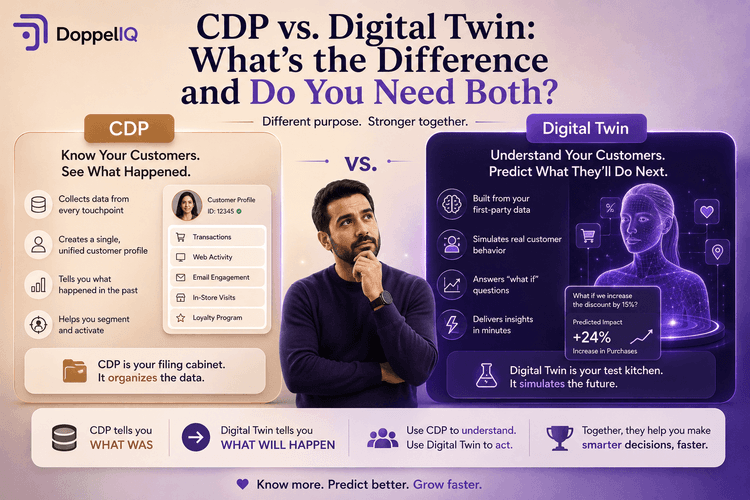
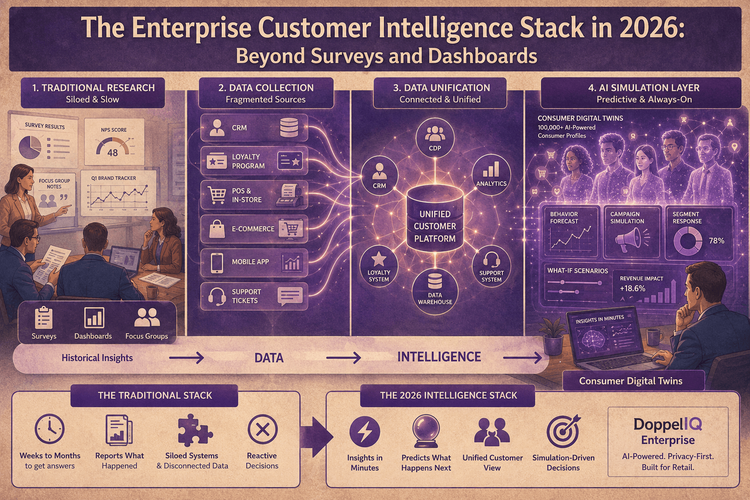
The Enterprise Customer Intelligence Stack in 2026: Beyond Surveys and Dashboards
Nehan Mumtaz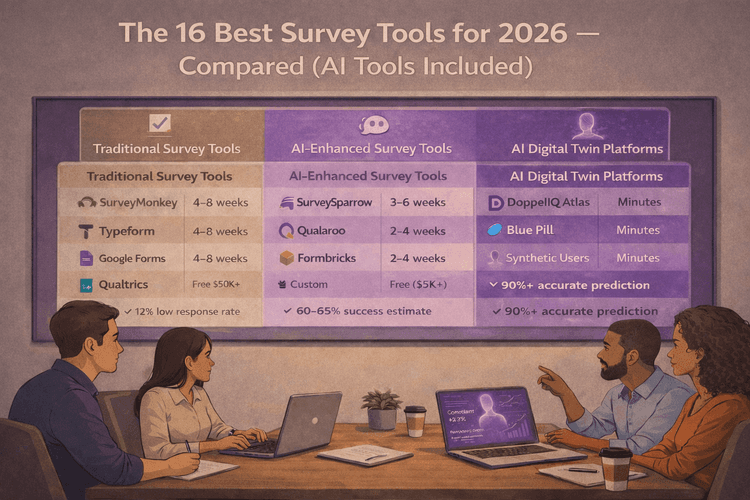
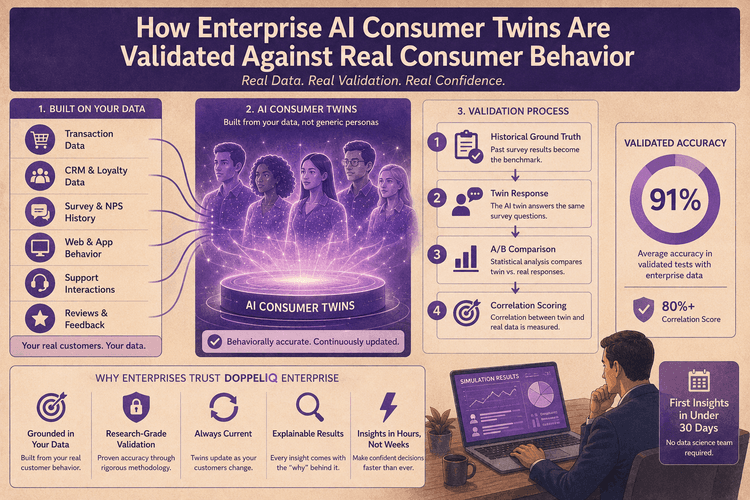
How Enterprise AI Consumer Twins Are Validated Against Real Consumer Behavior
Nehan Mumtaz