
The Enterprise Customer Intelligence Stack in 2026: Beyond Surveys and Dashboards
 Nehan Mumtaz
Most retail marketing teams are making million-dollar decisions based on research that's three months old. Sound familiar?
You ran a survey in Q1. The results came back in Q2. By Q3, your customers have moved on, new trends, new competitors, new preferences. And you're still building campaigns around what they used to think.
This is the core problem with how enterprises understand their customers today. It's not that the research is bad. It's that the whole system is built for a slower world. And the world of consumer insights is no longer slow.
In 2026, the enterprises winning in retail aren't just collecting more US consumer data. They're building a smarter intelligence stack that turns that data into decisions, fast. Here's what that looks like, and where it's all heading.
Why Enterprise Consumer Understanding Is Broken
Think of your current customer research setup like a rearview mirror. It shows you exactly where you've been. Useful? Yes. Enough to drive forward at full speed? Absolutely not.
Most large retail organizations today rely on a patchwork of:
-
Quarterly brand trackers sitting in a research team's inbox
-
NPS dashboards that flag problems weeks after they started
-
CRM data that doesn't talk to e-commerce data, which doesn't talk to loyalty data
-
Focus groups whose findings take 8 weeks to show up in a deck
Each of these tools does its job. The problem is they don't talk to each other, they don't update in real time, and by the time the insight reaches the decision-maker, the moment to act has usually passed.
The result? Marketers are forced to either move slow (and lose ground) or move fast (and guess). Neither is a great option when you're spending hundreds of thousands, if not millions of dollars on campaigns.
The Real Limits of Surveys, Dashboards, and Static Segments
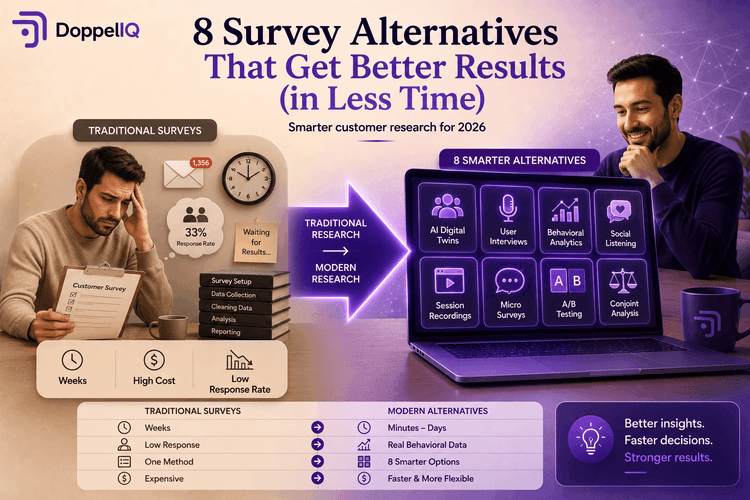
Let's be specific about where the traditional tools break down. This isn't about dismissing them, surveys still have value. But knowing their limits is what pushes you toward a better setup.
| Tool | What It Does Well | Where It Breaks Down |
|---|---|---|
| Surveys | Captures stated opinions | Slow timelines, low response rates, built-in bias |
| NPS Dashboards | Tracks satisfaction over time | Lags weeks behind real sentiment |
| Static Segments | Organizes customers by type | Freezes behavior at one point in time |
| Focus Groups | Digs into motivations | Expensive, small sample, hard to scale |
| A/B Testing | Validates what works | Requires live traffic, takes time to reach significance |
Over the last decade, companies have tried to overcome these limitations by investing heavily in analytics platforms, data warehouses, and data science teams.
And to be fair, they've made significant progress.
Today, organizations can track millions of customer interactions, build sophisticated dashboards, and uncover patterns that were impossible to see before.
But despite all that investment, most teams still struggle to answer a simple question:
What is this customer likely to do next?
The reason is that analytics systems are excellent at reporting and describing behavior, but they rarely create a unified understanding of the individual behind that behavior.
Customer data remains scattered across multiple systems.
Your loyalty platform sees one version of the customer.
Your e-commerce platform sees another.
Your CRM sees a third.
Your support platform sees a fourth.
Each system captures valuable signals, but none sees the complete picture.
As a result, teams end up making decisions based on reports, segments, and historical patterns rather than a continuously evolving understanding of the customer. They know what happened. They can often explain why it happened. But predicting what happens next remains surprisingly difficult.
That's the gap traditional research and modern analytics still haven't fully solved.
The Rise of AI-Powered Customer Intelligence
Here's the shift that's happening right now across retail.
Enterprises used to ask: "What did our customers do?"
Now the smartest ones are asking: "What will our customers do next, and how do we shape it?"
That shift from looking backward to looking forward is what separates a reporting tool from a real consumer insights platform.
The new generation of customer intelligence systems doesn't wait for a survey to come back. They pull from everything, your transactions, your CRM, your loyalty data, your web analytics, your support tickets, and synthesize it into a living model of your customer base. Then they let you ask questions and run experiments against that model, in real time.
This is the world of AI-powered consumer intelligence. And the most advanced version of it is what's called a Consumer Digital Twin.
What Enterprise Digital Twins Actually Are
Imagine if you could hire a team of 10,000 customer clones, all based on real people who actually shop with you, and ask them anything, any time, with results back in minutes.
That's essentially what a Consumer Digital Twin does.
A digital twin is an AI model of your actual customers, built from your own behavioral and transactional data. It's not a made-up persona. It's not a chatbot pretending to be a customer. It's a simulation engine trained on real purchase history, browsing patterns, loyalty behavior, and demographic signals from your specific customer base.
When you ask a digital twin "How would our deal-seekers respond to a 15% price drop on our core SKU?", it doesn't guess. It simulates responses based on how those actual customer segments have historically behaved around discounts, cart abandonment, and price sensitivity.
One key thing to understand: this is very different from asking a general AI tool the same question. A general AI gives you a textbook answer. A digital twin gives you your answer, grounded in your customers' actual behavior patterns. Here's a deeper look at how digital twin accuracy actually works.
How First-Party Data Makes the Difference
Think of first-party data as the difference between asking a stranger for directions and asking someone who's driven that exact route 50 times.
Generic AI tools are the stranger. They know the general neighborhood. But your Customer Digital Twin has actually been there, because it's built on what your customers have actually done, on your website, in your stores, in your loyalty program.
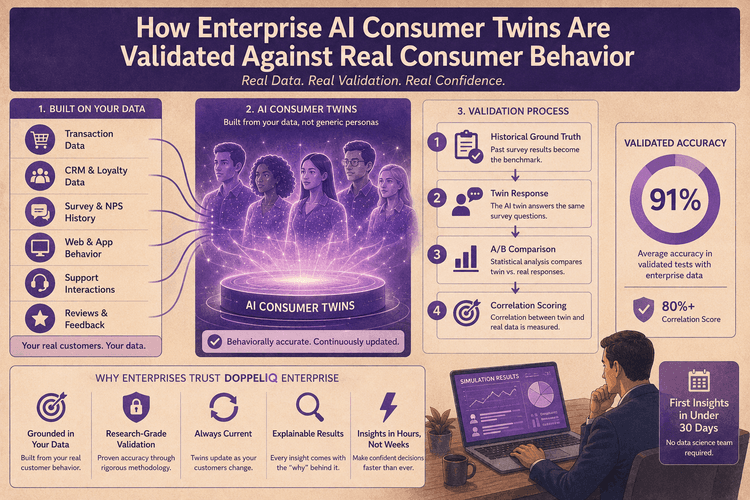
Here's what goes into a well-built enterprise digital twin:
| Data Type | Examples | What It Unlocks |
|---|---|---|
| Transaction Data | Purchase history, POS records, e-commerce | Price sensitivity, brand affinity, buying frequency |
| CRM / Loyalty Data | Rewards activity, churn history, segments | Retention risk, upsell potential |
| Web & App Behavior | Clickstream, A/B test logs, app usage | Journey simulation, feature adoption |
| Survey & Research | NPS scores, focus group transcripts | Attitudinal calibration |
| Support Interactions | Ticket topics, resolution patterns | Complaint prediction, friction mapping |
| Product Catalog | SKUs, pricing, attributes | Price testing, launch simulation |
When you connect all of these into one model, something powerful happens: you stop seeing seven siloed data sources and start seeing one customer. That's the single source of truth that most retail organizations have been chasing for years, and first-party data is what makes it reliable.
Real Use Cases: What You Can Actually Do With Digital Twins
This is where it gets practical. Here's how retail marketing teams are using digital twins right now:
Campaign Testing Before You Spend Run a promotion concept past 10,000 simulated customers before you commit budget. See which segments respond, which don't, and why, in minutes, not months. Instant consumer insights are no longer a dream.
Creative and Messaging Testing Want to know if your new campaign tagline lands with your health-conscious segment vs. your deal-seeker segment? Ask the twin. Concept testing without surveys is now possible at the speed of a team meeting.
A/B Testing Without Live Traffic Traditional A/B testing needs real visitors and weeks of data. Digital twins let you simulate the test first, so you already know which version is likely to win before you go live.
Loyalty Optimization Ask your customer models which reward structures drive repeat visits vs. which ones just get gamed. Simulate new tier structures before rolling them out.
Segment Response Forecasting Launching in a new region or targeting a new demographic? Simulate how that segment behaves before you invest in acquisition.
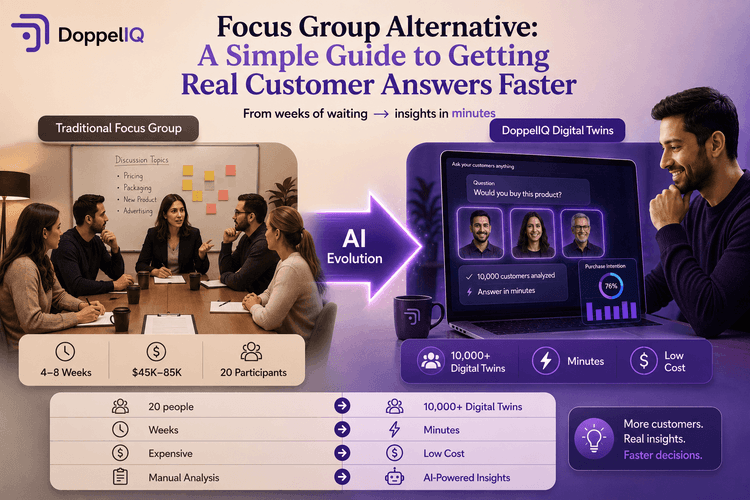
Virtual Focus Groups Instead of flying six customers to Chicago for a two-hour session, run a virtual focus group across thousands of simulated participants, and get results the same day.
What the Enterprise Intelligence Stack Looks Like in 2026
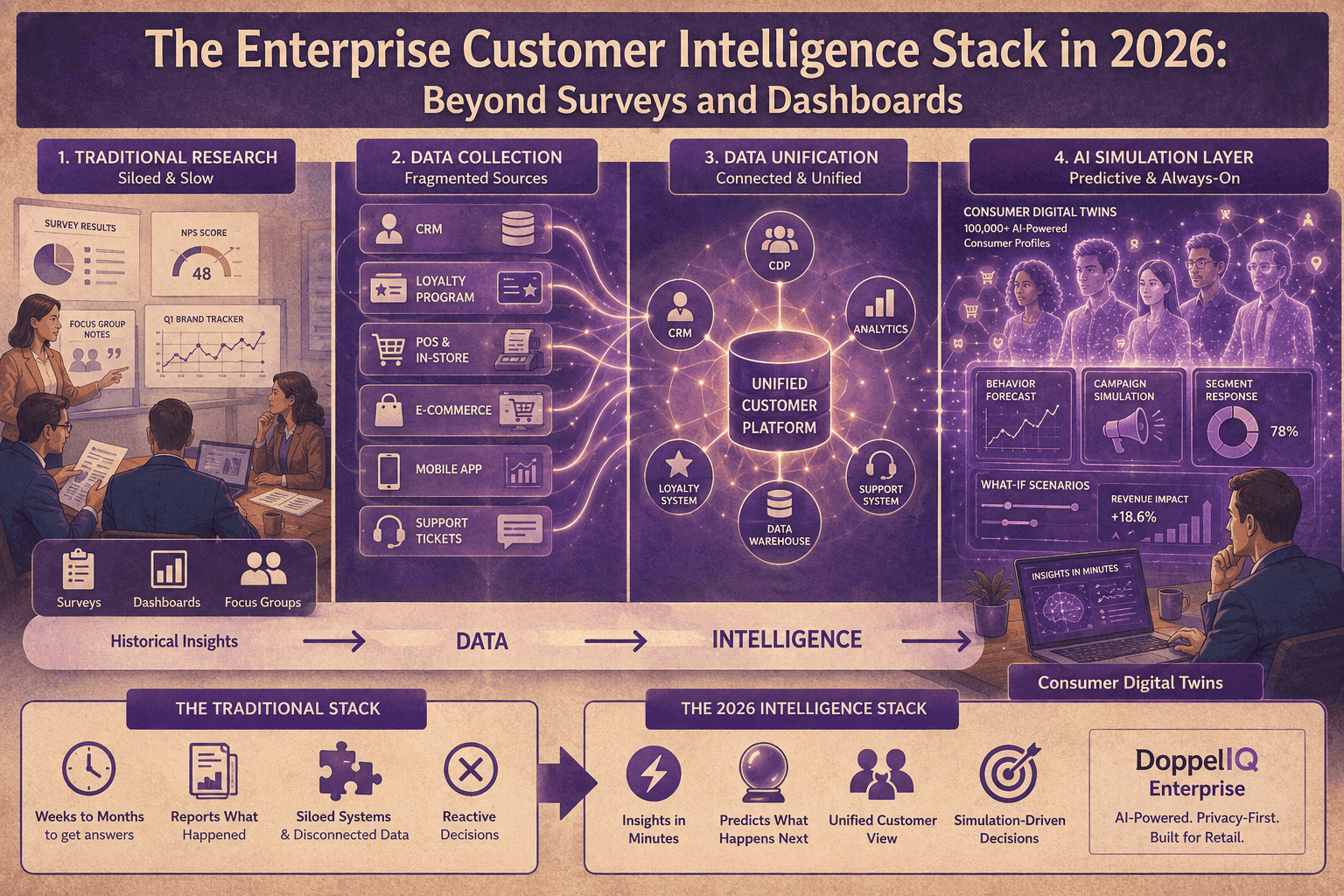
Here's the simplest way to think about how the modern stack is layered:
| Layer | What It Does | Examples |
|---|---|---|
| Data Collection | Captures raw signals | POS, e-commerce, CRM, CDP, loyalty apps |
| Data Unification | Connects the silos | Customer Data Platforms (CDPs) |
| Reporting & Analytics | Shows what happened | BI dashboards, analytics tools |
| AI Simulation Layer | Predicts and simulates what will happen | Consumer Digital Twins |
Most enterprises in 2025 have the first three layers. What they're missing is the fourth, the layer that turns all that stored data into forward-looking intelligence.
DoppelIQ Enterprise sits at that fourth layer. It ingests from your CDP, CRM, ERP, and behavioral systems, builds digital twins of your actual customers, and gives your marketing and insights teams a simulation platform they can query in plain English, no data science background needed.
Results come back in minutes. Twins update continuously as new customer behavior comes in. And the whole system is built on your data, inside a private container, with no PII stored anywhere.
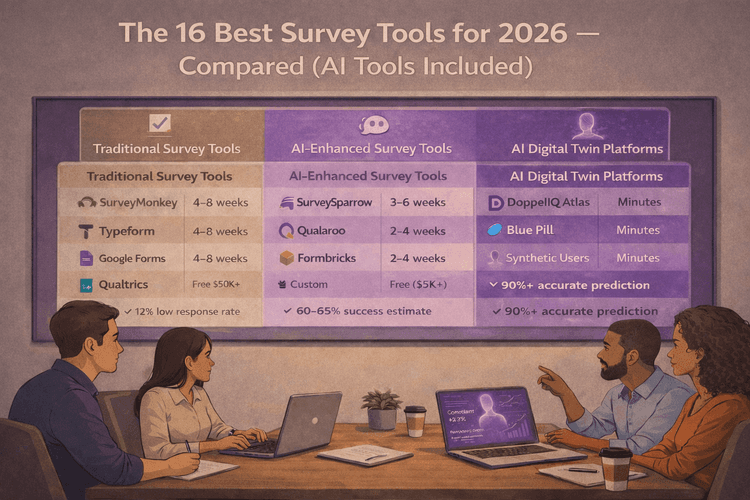
The result is a customer intelligence engine that's always on, not just when you run a survey. See how this compares to other research approaches.
Frequently Asked Questions
How is a Consumer Digital Twin different from a customer persona?
A persona is a static profile someone made in a workshop. A digital twin is a dynamic simulation built from real behavioral data, it updates as your customers change, and you can run experiments against it. Here's the full breakdown.
How accurate are digital twin responses compared to real surveys?
In validated enterprise deployments, DoppelIQ's digital twins reach approximately 91% accuracy against real historical survey responses, with correlation scores consistently above 80%.
Do I need to replace my existing research tools?
No. Digital twins work alongside your existing surveys and dashboards, they make those inputs more useful by combining them with behavioral data, not replacing them.
What data does my company need to get started?
Transaction history and customer records are the core starting point. DoppelIQ can build a working prototype from a few months of data and expand accuracy as more data sources are connected.
Is customer data safe when building digital twins?
Yes. DoppelIQ Enterprise uses end-to-end encryption, deletes raw source files within 7 days of twin creation, and never stores personally identifiable information (PII).
How long before we see real results?
Most enterprise clients receive their first actionable insights within 4 weeks of onboarding. After that, queries return results in minutes.
Can my marketing team use this without a data science background?
Yes. The interface works like a research dashboard, you type your question in plain English and get a response. No coding required.
What's the difference between synthetic respondents and digital twins?
Synthetic respondents are AI-generated survey participants. Digital twins are a more advanced version: they're built from your proprietary customer data, making them specific to your actual customer base rather than a generic population. Learn more about synthetic respondents.
Can digital twins be used for market segmentation?
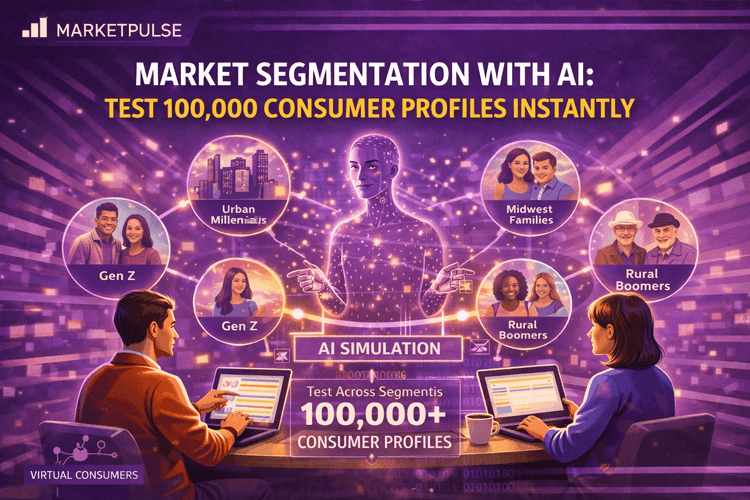
Absolutely. Digital twins are one of the most powerful tools for AI-driven market segmentation because they simulate how different segments actually behave, not just how they describe themselves.
Ready to See What Your Customers Will Do Next?
Your customers are changing faster than any quarterly survey can track. The enterprises that win in 2026 will be the ones that move from episodic research to always-on intelligence, from asking "what happened?" to simulating "what will happen?"
Book an Enterprise Demo — See DoppelIQ built on your actual customer data.
Related Articles

How beauty brands use digital customer twins to get insights and win in a competitive segment
 Ankur Mandal
Customer digital twins vs focus groups vs ChatGPT: Concept testing in market research
Ankur Mandal


Population-Scale Consumer Research: How 100,000 AI Twins Beat 1,000 Survey Responses
Nehan Mumtaz
Digital Twin Accuracy: Can AI Really Predict Consumer Behavior? (2026 Benchmark Data)
Nehan Mumtaz
Focus Group Alternative: A Simple Guide to Getting Real Customer Answers Faster
Nehan Mumtaz
Concept Testing Without Surveys: How AI Simulation Unlocks Your Full Product Potential
Nehan Mumtaz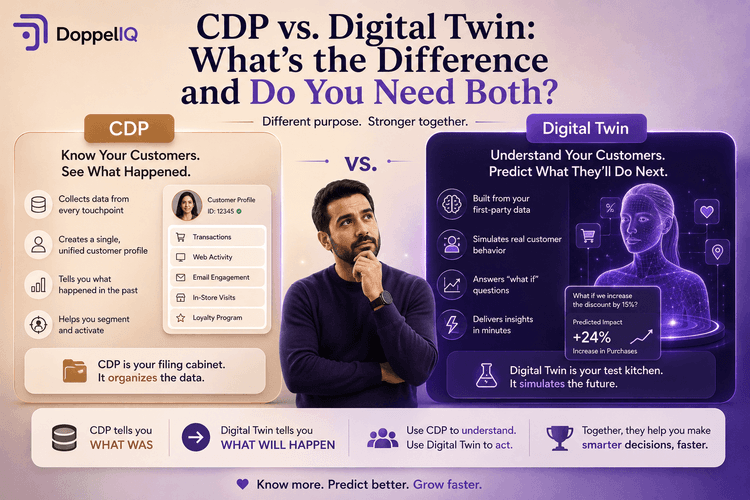
How Enterprise AI Consumer Twins Are Validated Against Real Consumer Behavior
Nehan Mumtaz