
The $100 Million Gamble: Why Traditional Data Failed Jaguar (And Why It Will Fail You)

Ankur Mandal
Founding Member
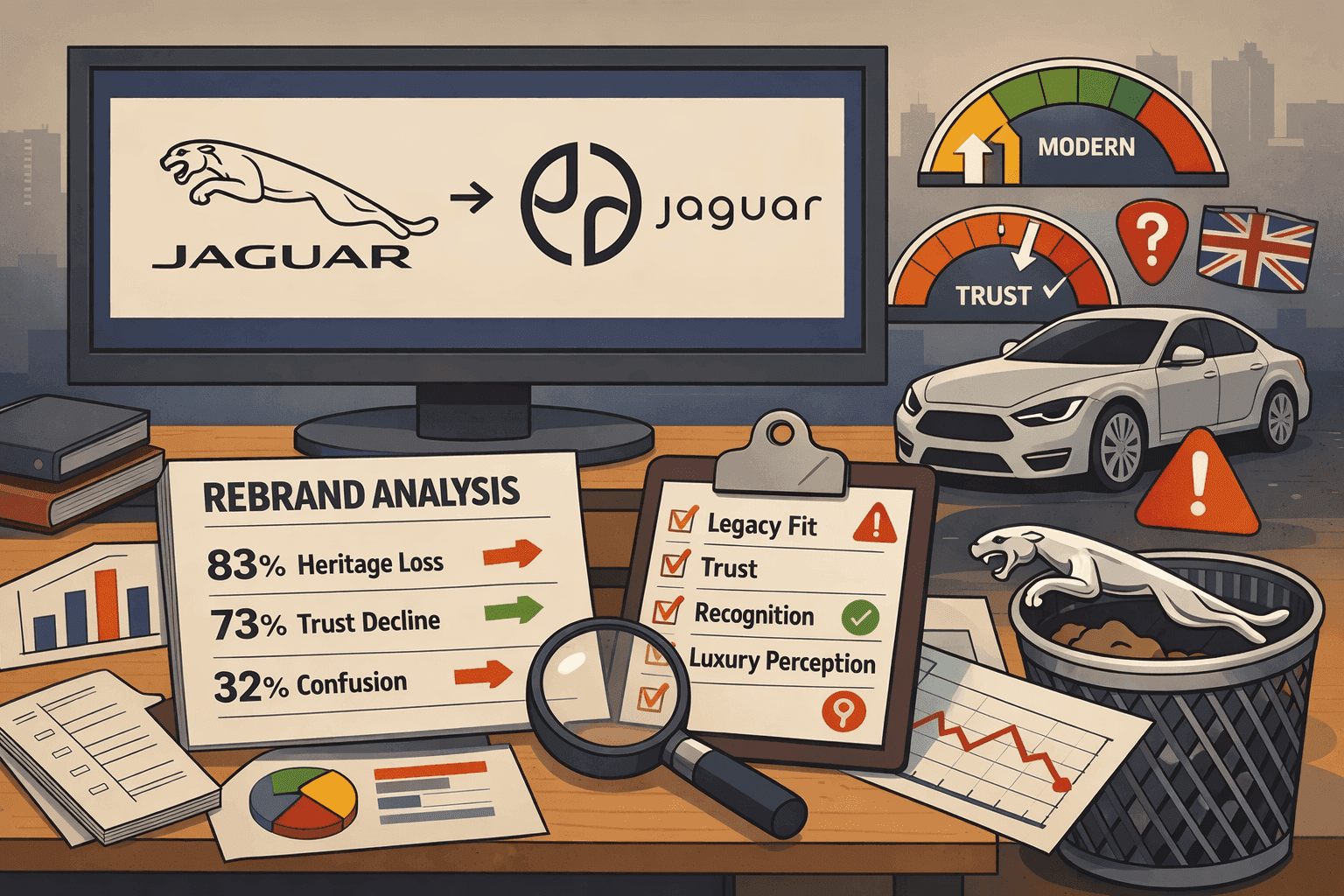
The recent backlash against Jaguar’s rebrand wasn't a failure of creativity; it was a failure of certainty. In an era where CMOs have access to "Big Data," how does a legacy brand still misread the room so profoundly? The answer lies not in the quantity of data, as Jaguar likely surveyed thousands, but in the quality of the instrument. This article analyzes the Jaguar case study through the lens of AI Digital Twins, demonstrating how the "Traditional Route" of consumer research is structurally flawed and how predictive behavioral simulation is the only way to de-risk the modern rebrand.
The Silence in the Boardroom
There is a specific kind of silence that falls over a boardroom when a "Bold New Direction" is unveiled. It is a silence mixed with exhilaration and terror.
Consider the room where the decisions were finalized before Jaguar launched its new logo and brand campaign in November 2024. The strategy was sound on paper: Pivot to electric. Shed the dusty "old luxury" image. Capture the Tesla generation. The creative agency likely presented a deck that was visually stunning, minimalist, abstract, and aggressively modern. They promised disruption.
And they delivered. But disruption, as Jaguar learned the hard way, is a double-edged sword. You can disrupt the market, or you can disrupt your own revenue stream.
When the rebrand launched, the market didn't just shrug; it recoiled. The "Modernity" they paid for arrived packaged with "Confusion" and "Distrust."
We must be empathetic here. The marketing leadership at Jaguar is not incompetent. They almost certainly did their due diligence. They likely commissioned the traditional route: massive surveys, N=10,000 respondents, global focus groups, and expensive consultancy reports.
Ten years ago, that would have been the gold standard. There was no better way. You asked people what they thought, and you hoped they told the truth.
But today, relying on that method is an act of negligence.
We ran a "Pre-Mortem" on the Jaguar rebrand using DoppelIQ, our engine of AI Digital Twins. We didn't ask 10,000 people. We simulated the behavioral response of 100 core archetypes. The results were available in minutes, not months. And they predicted the exact PR disaster that Jaguar is now managing.
Here is why the old way failed and why the new way is the only path to certainty.
- Shows how a rebrand can “pass” research and still fail in market.
- Quantifies the hidden trade-offs brands rarely measure.
- Demonstrates a better way to de-risk high-stakes brand decisions.
The "N=10,000" Fallacy: Why Traditional Surveys Lie
Let’s dismantle the defense that "we did the research."
You can survey 10,000 people. You can outsource to the most prestigious firm in London or New York. You can have a sample size that satisfies every statistician on your payroll.
But the fundamental flaw remains: You are surveying humans.
Human respondents are notoriously unreliable narrators of their own future behavior.
-
The "Mood" Variable: A respondent’s answer is heavily influenced by their day. Did they hit traffic? Are they hungry? A "7/10" purchase intent on Tuesday might be a "2/10" on Wednesday.
-
The Context Bias: In a survey or focus group, people are in "Judgment Mode." They become art critics. They analyze the logo intellectually ("Yes, this font looks modern") rather than reacting viscerally ("I don't trust this brand anymore").
-
The "Good Subject" Effect: Respondents unconsciously try to please the researcher. If the prompt asks, "Does this look future-forward?", they are primed to say yes.
Jaguar likely had data saying the rebrand was a success. But that data was polluted by human bias.
Enter the Digital Twin. At DoppelIQ, we don't ask people. We create Synthetic Users, AI models conditioned on thousands of data points to replicate the specific behavioral psychology of a "Luxury Buyer" or a "Tech Early Adopter."
Digital Twins do not have "bad days." They do not lie to be polite. They do not get hungry. They simply process the stimulus through their behavioral framework and output the raw probability of their reaction.
This removes the noise and leaves only the signal. And in Jaguar's case, the signal was a siren.
The Autopsy: A Strategic Disconnect
We fed the Jaguar rebrand assets into DoppelIQ. The resulting data exposes the precise moment where the strategy fractured.
1. The "Modernity vs. Trust" Trade-Off
Every strategic decision has a cost. The goal of the rebrand was Modernity. Our Digital Twins confirmed this success.
-
Modernity Score: 100% Positive.
- Analysis: The AI acknowledged the minimalist aesthetic as "contemporary" and "forward-thinking."
However, the traditional analysis likely stopped there. The Digital Twin simulation revealed the hidden cost.
-
Trust Score: 73% Negative.
- Analysis: Nearly three-quarters of the simulated cohort expressed a significant drop in trust.
The Strategic Insight: In the Chase Hughes Authority Matrix, a behavioral framework we utilize for deep profiling, Authority is the sum of Competence plus Trust. Jaguar signaled high Competence (Tech/Modernity) but obliterated Trust (Heritage/Warmth). When a consumer sees High Novelty and Low Trust, their brain does not categorize the brand as "Exciting." It categorizes it as "Unstable."
Traditional surveys likely asked, "Is this modern?" (Yes). They failed to ask, "Does this modernity make you suspicious?" (Yes).
2. The Cognitive Friction of "Confusion"
Brand equity is built on recognition. The speed at which a consumer recognizes your brand on a billboard is directly correlated to purchase intent.
Our data identified a critical failure point:
- 32% of respondents fell into the "Confused" sentiment bucket.
The new logo, an abstract mix of upper and lowercase letters, created Cognitive Friction. The Digital Twins, acting as proxies for real human brains, flagged the logo as "ambiguous."
-
Legacy Reaction: See Leaping Cat -> Recognition -> Emotion -> Desire.
-
New Reaction: See Text -> Confusion -> Decoding -> "Oh, it's Jaguar?" -> Apathy.
In a high-stakes luxury market, making your customer work to understand who you are is a fatal error. Confusion is the enemy of conversion.
3. The Breach of the Tribal Contract
Perhaps the most damning metric was the alienation of the core customer base.
- 83% felt the brand moved "Too Far" from its heritage.
Brands function as Tribal Badges. A Jaguar was a symbol of "British Power and Elegance." By removing the "Leaping Jaguar" (the Leaper) and the "Growler" (the face), the brand effectively stripped its loyalists of their badge.
The HBR Perspective: This is a classic failure of Customer Lifetime Value (CLTV) management. In the pursuit of a hypothetical new customer (the young, tech-savvy EV buyer), Jaguar alienated the existing customer who funds the R&D. The data shows this wasn't an evolution; it was an eviction.
The "Pre-Mortem": A New Standard for Executive Diligence
The tragedy is that Jaguar’s leadership likely believed they were being courageous. And they were. But courage without certainty is just gambling.
We are proposing a shift in how marketing assets are greenlit. We call it the Pre-Mortem.
A Post-Mortem is an autopsy; it explains why the patient died. A Pre-Mortem is a simulation; it reveals how the patient might die so you can change the treatment plan.
If Jaguar had run a DoppelIQ Pre-Mortem, the report would have landed on the CMO's desk with a clear warning:
"Warning: Modernity goals achieved, but Trust metrics have collapsed. The 'Confusion' index is at 32%, suggesting the new logo is too abstract. Recommendation: Retain the 'Leaping Cat' as a bridge element to maintain Heritage scores while introducing the new typography."
This insight would not have cost millions. It would not have taken six months. It would have saved the brand from a global PR crisis.
The Evolution of Insight
We must acknowledge that for decades, marketers did the best they could with the tools they had. We relied on focus groups because we couldn't clone our customers. We relied on intuition because we didn't have predictive simulation.
But "It was the best we had" is no longer an acceptable defense.
The technology now exists to decouple data from human error. Consumer Digital Twins offer a pristine, bias-free environment to stress-test your strategy. They allow you to be aggressive, to be bold, and to be disruptive, but with a safety net.
Conclusion: The ROI of Certainty
The Jaguar case study will be taught in business schools for the next decade. It will be framed as a clash between "Heritage" and "Future."
But the real lesson is about Risk Management. In the high-stakes arena of global branding, intuition is a liability. The mood of a focus group is a variable you cannot afford.
The future of marketing belongs to those who clone their customers before they convert them. It belongs to the leaders who refuse to guess.
Don't wait for the backlash. Predict it.
Get DoppelIQ Insights Directly in your Inbox
Stay updated with our latest research, insights, and industry trends delivered straight to your inbox.